
Last updated: November 2, 2026.
How did people move lumber and stone around Morrison, Colorado in the 1870s? They used teams of oxen and horses on wagon roads, some of which charged a toll, and after 1874 they also used a narrow-gauge train. This post explains how a lumber wagon worked, who paid to use the roads, and why Morrison was a busy little town.
Quick facts
⛰️
Morrison
George Morrison laid out the town in 1874 and founded the Morrison Stone, Lime, and Town Co.
🚂
The train
the Denver, South Park and Pacific Railroad reached Morrison on June 20, 1874. Its tracks were narrow gauge, set 3 feet apart.
🛣️
Toll roads
toll roads ran through Bear Creek Canyon and Turkey Creek Canyon. One list gives a toll of 25 cents for a team and wagon.
🐂
Oxen
a team of oxen walked about 2 miles an hour.
💡 Did you know? Red Rocks Park, near Morrison, was once known as the Garden of the Angels.
Timeline: Morrison in the 1870s
1874
George Morrison plats the town of Morrison.
June 20, 1874
Railroad tracks reach Morrison.
July 3, 1874
Regular train service begins between Denver and Morrison.
1876
Colorado becomes a state.
A town built on stone
Morrison grew because of what lay under the ground. George Morrison platted the town in 1874, and he founded the Morrison Stone, Lime, and Town Co. The area had a red sandstone quarry, and workers also produced lime and gypsum, materials used in building. The railroad brought building stone and other products of Morrison’s quarries into Denver.
When the Denver, South Park and Pacific Railroad reached Morrison on June 20, 1874, regular train service started on July 3. After the Panic of 1873, which was a big money crisis, and after crop losses in 1874 to 1876, the railroad did not build farther for years. So in the 1870s Morrison was a busy place at the end of the tracks.
Wagons and toll roads
Not everything went by train. People who lived up the canyons used wagons. A Jefferson County history brochure says toll roads, which are roads that charge a fee, were first authorized by territorial lawmakers. Toll roads ran through Bear Creek Canyon and Turkey Creek Canyon, near Morrison. The brochure lists fees such as 25 cents for a team and wagon, 10 cents for each horse, and 5 cents for each sheep, goat or hog. It does not date those exact prices to the 1870s, so treat them as an example of how tolls worked, not as the price in a particular year.
Oxen are not horses
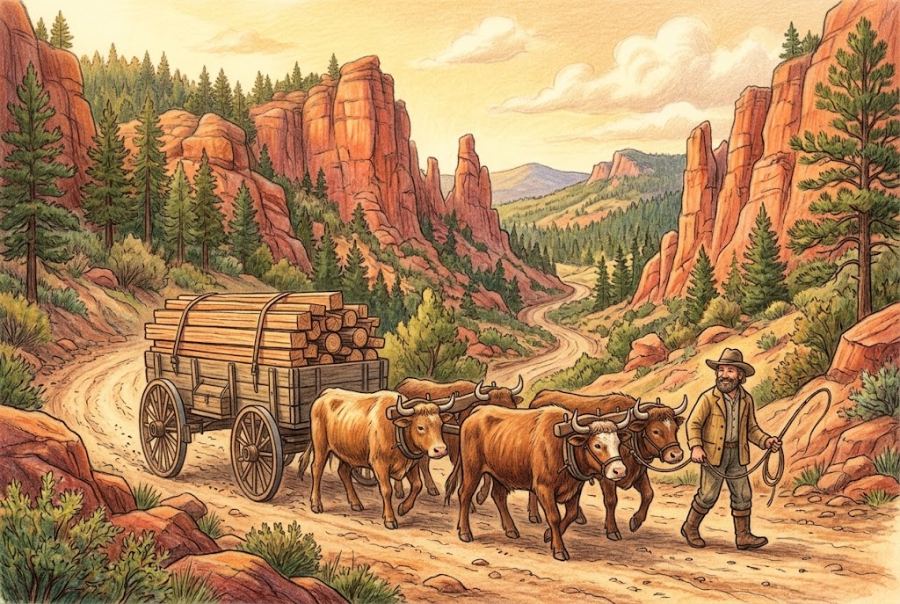
A team of oxen worked very differently from horses. On the overland trails, the driver walked on the left side of the team and used his voice, body language and a whip to guide the animals. The National Park Service says the usual pace was about two miles an hour. At that speed a trip of ten miles takes five hours. A driver had a long day just to deliver a load.
Trees from the hills
Higher up Bear Creek, logging drew settlers to the area that became Evergreen. A half-dozen sawmills worked along upper Bear Creek. A load of lumber from the hills meant long hours for a teamster, which is a person who drives a team of animals pulling a wagon.
A real teenager with oxen
Elias Ammons, who later became governor of Colorado, did this kind of work. He drove oxen hauling cordwood to limekilns, the ovens that burned limestone to make lime. You can read about him in our post on Elias Ammons.
One thing we do not know is where he was in the summer of 1876, so we cannot say what he hauled that year.
Try this at home
- Ten miles at two miles an hour takes five hours. How long would it take you to walk ten miles?
- Why would a road charge a toll, and who would not want to pay it?
- Why is a train better for heavy stone than an ox team? Is a wagon ever better?
What is real and what is made up
The towns, the roads and the railroad above are real. The story of The Wrong Choice, in which two boys from today land on a hill above Morrison in 1876, is made up. The book ends with a What Was Real? page that sorts the facts from the story.
This story comes from TRACE in Colorado by T. A. Held, a time-travel series for ages 9 to 12 with a What Was Real? page in every book.
Read the book: The Wrong Choice (Book 1) · See all the TRACE in Colorado books
Previous post: The grasshopper plague of 1876: when swarms ate Colorado’s crops
Next post: What was a fancy hotel like in Denver in 1876? The Inter-Ocean and the Tremont House
Sources
- George Morrison, Morrison History
- Early Morrison, Morrison History
- Morrison, Colorado, Wikipedia
- Denver, South Park and Pacific Railroad, Wikipedia
- Historic Transportation in Jefferson County (brochure), Jefferson County
- Oxen: Engines of the Overland Emigration, National Park Service
- Evergreen, SAH Archipedia
- Denver County, History of Colorado, Biographies: Ammons, Elias Milton (published 1918)
Leave a Reply