
Last updated: November 2, 2026.
Where would you sleep and eat if you arrived in Denver in 1876? A fancy traveler might choose the Inter-Ocean Hotel, with its bronze chandeliers and speaking tubes. This post tells what historians know about Denver’s hotels, and it is honest about the one thing we could not find: the menu.
Quick facts
🏨
The Inter-Ocean Hotel
it opened on October 29, 1873, at 16th and Blake Streets in Denver. Barney Ford built it, and it was a four-story building.
🏨
The Tremont House
it began in late 1859 near Cherry Creek as an alcohol-free boardinghouse called the Temperance Hotel.
🦪
Oysters
ice-cooled railroad cars let oysters be served daily in large cities and small towns.
❓
Missing
we found no menu or meal price for a Denver hotel in 1876.
💡 Did you know? The Inter-Ocean was used for about 100 years. It was torn down in 1973 to make a parking lot.
Timeline: two famous Denver hotels
Late 1859
The Temperance Hotel opens near Cherry Creek. It is later renamed the Tremont House.
1872
Barney Ford buys lots at Blake and Sixteenth Streets.
Oct 29, 1873
The Inter-Ocean Hotel opens.
1876
John Wesley Smith buys the Inter-Ocean.
1912
A flood fills the Tremont House with mud, and it is torn down.
1973
The Inter-Ocean is demolished for a parking lot.
1988-89
Archaeologists dig at the Tremont House site and find about 26,000 objects.
The Inter-Ocean Hotel
The Inter-Ocean was built by Barney Ford, who bought the lots at Blake and Sixteenth Streets in 1872. It opened in 1873 as the finest hotel in Denver. It had a Second Empire style, which means a building with a mansard roof, a roof with steep sides. William Byers, the editor of the Rocky Mountain News, praised it as the finest hotel in the territory.
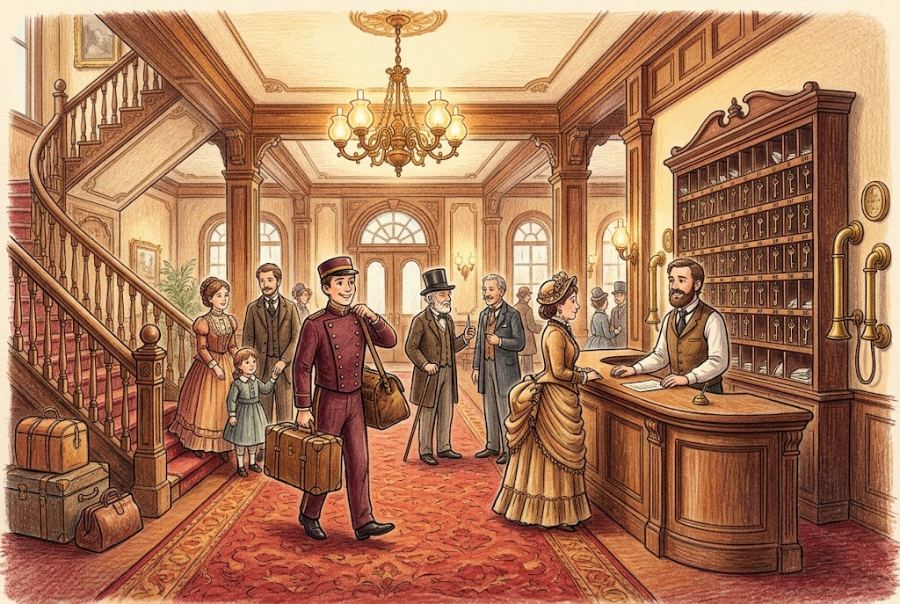
Inside, the second floor had bronze chandeliers, velvet drapes and lace curtains. The front desk was a half circle. Behind it hung a rack of keys made of black walnut. The hotel also had a call system, with wires to every room, and speaking tubes on each floor, so a guest could talk to the desk without walking downstairs. In 1876, a man named John Wesley Smith bought the hotel.
The Tremont House
Another famous hotel stood closer to Cherry Creek. It opened in late 1859 as a boardinghouse that did not allow alcohol, called the Temperance Hotel. It was later renamed the Tremont House. By the 1880s it had lost some of its fame. A flood in 1912 filled it with mud and sand, and it was torn down that year. In 1988 and 1989 archaeologists dug at the site and found about 26,000 objects. The site now lies under Speer Boulevard.
What did people eat?
Here is the honest part. We know a lot about the buildings but nothing about a particular Denver hotel dinner in 1876. We found no menu and no price for that year. What we do know is how food traveled. Ice-cooled railroad cars changed how food was moved, and oysters began to be served daily in big cities and small towns across the country. A guest at a good hotel might have found food that came from far away. We cannot say that a certain Denver hotel served oysters on a certain night, so we will not say it.
Why say what we do not know?
A good historian says “I don’t know” when the record is silent. When a writer of a made-up story fills in details, they should be marked as made up. That is why each TRACE in Colorado book ends with a What Was Real? page.
Try this at home
- What would you ask the hotel desk through a speaking tube?
- A hotel bought by a new owner in 1876 had been open only three years. Why might owners change so quickly?
- If you found a hotel menu from 1876, what would you look for first?
What is real and what is made up
The hotels above are real. In The Wrong Choice, two boys from today arrive in 1876 with no money and nowhere to sleep, but their story is made up. The book ends with a What Was Real? page that sorts the facts from the story.
This story comes from TRACE in Colorado by T. A. Held, a time-travel series for ages 9 to 12 with a What Was Real? page in every book.
Read the book: The Wrong Choice (Book 1) · See all the TRACE in Colorado books
Previous post: How did people haul lumber and stone near Morrison in the 1870s?
Next post: Trivia quiz: Denver in 1876 (3 questions with answers)
Leave a Reply