
Last updated: November 2, 2026.
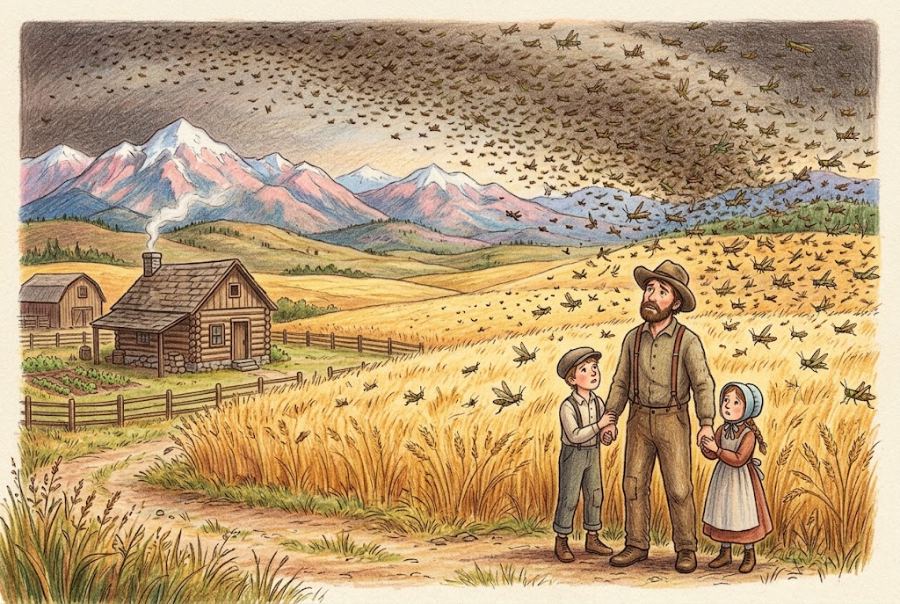
What was the grasshopper plague in Colorado in 1876? From 1874 to 1876, giant swarms of grasshoppers, called Rocky Mountain locusts, ate crops across the plains. Colorado farmers faced the plague three years in a row. This post tells what happened, what the government did, and a surprising end to the story.
Quick facts
📅
When
swarms hit Colorado three years running, and the last great swarm came in 1876. Across the West, the last major swarms were from about 1873 to 1877.
📍
Where
Colorado, Kansas, Minnesota, Missouri, Nebraska and other states.
🤝
Help
Congress voted money to help farmers who had lost their crops.
😄
The joke
farmers said the locusts ate everything but the mortgage.
💡 Did you know? The Rocky Mountain locust is now extinct. The last specimen anyone collected was in 1904, in Colorado.
Timeline: three bad years and a long goodbye
1874
Swarms of Rocky Mountain locusts ravage crops on the plains.
Jan 1875
Congress sets aside money to buy seed for farmers.
1876
The last great swarm reaches Colorado, in the summer Colorado becomes a state.
1904
The last Rocky Mountain locust specimen is collected, in Colorado.
2014
The IUCN formally declares the species extinct.
Clouds of insects
Today a grasshopper is a small insect in the grass. The Rocky Mountain locust was a type of grasshopper that sometimes gathered in huge swarms and flew across the land. When a swarm landed on a farm, the insects could eat the crops down to the ground. For a family that grew its own food and sold the rest, that could mean a hungry winter.
Three years in a row
Colorado farmers were hit by swarms in 1874, 1875 and 1876. People found it hard to keep going, because a farmer who loses a crop must still pay for seed, tools and land. Farmers joked bitterly that the locusts ate everything but the mortgage. A mortgage is a loan used to buy land. The joke means that the insects ate the crops but the debt remained.
What did the government do?
The plague was serious enough that Congress acted. Congress voted money to help people on the western frontier who had been left destitute by the grasshoppers. In January 1875, it also set aside money to buy seed, so farmers could plant again. Sources give different dollar amounts for the different relief laws, so we will not print a number.
The newspaper and the grasshoppers
When Colorado became a state on August 1, 1876, newspapers were also writing about the swarm. The Rocky Mountain News joked that anyone who hoped statehood would end the grasshopper problem had slipped up. You can read the whole story in our post about the day Colorado became a state.
A mystery with a real ending
After the late 1870s, the great swarms stopped. The last specimen of the Rocky Mountain locust was collected in 1904, in Colorado. Less than thirty years after the biggest swarms, the species seemed to be gone. In 2014 the IUCN, the group that keeps the world list of endangered species, formally declared the Rocky Mountain locust extinct. Scientists still talk about why such a huge insect population could disappear so fast. We could not find one answer that is agreed upon, so we will not claim one.
Try this at home
- Why would a farmer need money for seed after a swarm ate the crop?
- The joke about the mortgage is dark humor. Why do you think people tell jokes in hard times?
- A species with millions of insects went extinct. What does that tell us about nature?
What is real and what is made up
The grasshoppers, the relief laws and the extinction are real history. The Wrong Choice is a made-up time-travel adventure that begins in Morrison in 1876. Its What Was Real? page explains which parts of its world come from the real history of that year.
Not only a Colorado problem
The swarms were not a Colorado problem alone. Across the West, the last major swarms came between about 1873 and 1877 in Colorado, Kansas, Minnesota, Missouri, Nebraska and other states. A farmer on the plains who read about help in Washington was reading about a problem shared by thousands of other families. That is one reason Congress, which had to answer to all of those states, took notice.
This story comes from TRACE in Colorado by T. A. Held, a time-travel series for ages 9 to 12 with a What Was Real? page in every book.
Read the book: The Wrong Choice (Book 1) · See all the TRACE in Colorado books
Previous post: How did news travel in 1876? Telegraphs, newspapers and printer’s devils
Next post: How did people haul lumber and stone near Morrison in the 1870s?
Leave a Reply