Last updated: November 2, 2026.
When did Colorado become a state? The answer is August 1, 1876, and the way Denver reacted may surprise you: hardly anyone threw a party. Here is what really happened on the day Colorado joined the United States, why it is called the Centennial State, and why the big celebration had already happened a month earlier.
Quick facts
📅
Date
August 1, 1876. President Ulysses S. Grant signed the proclamation that made Colorado a state.
🔢
Order
Colorado was the 38th state to join the United States.
🏷️
Nickname
Colorado is the Centennial State, because it joined in the year the country turned 100.
🎉
Holiday
August 1 is still celebrated in Colorado as Colorado Day.
💡 Did you know? The name “Centennial State” was already in print in a Denver newspaper, the Denver Times, on February 27, 1875, about a year and a half before Colorado became a state.
Timeline: from the Declaration to a new state
July 4, 1776
The Declaration of Independence is adopted.
Feb 27, 1875
The Denver Times prints “Centennial State” for the first time.
July 4, 1876
Denver celebrates the nation’s 100th birthday: bells, a sunrise salute, a parade and fireworks.
Aug 1, 1876
President Grant signs the proclamation. Colorado is the 38th state.
Aug 2, 1876
The statehood telegram is printed in Colorado and national newspapers.
October 1876
Elections are set for the first Tuesday in October.
Why “Centennial”?
The word centennial means a hundredth anniversary. The United States adopted the Declaration of Independence in 1776, so July 4, 1876 was its 100th birthday. People all over the country marked the date, and a giant world’s fair called the Centennial Exposition ran in Philadelphia from May 10 to November 10, 1876. Colorado joined the Union only four weeks after that birthday.
The Denver Times saw it coming. Its writers expected Colorado to be admitted at the hundredth anniversary of American independence, and the nickname stuck.
What the Fourth of July looked like in Denver
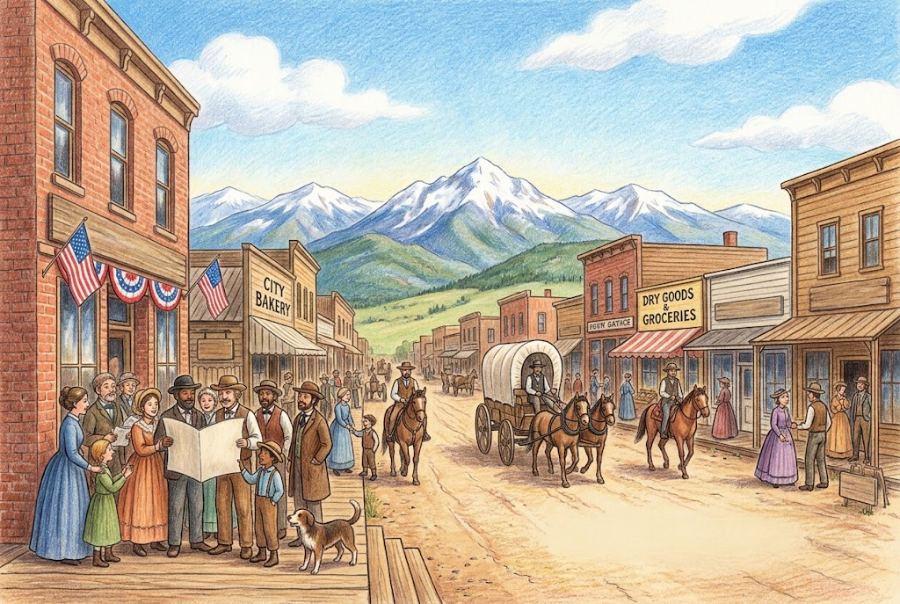
Denver did not hold back on July 4, 1876. According to a history of that day published by Colorado Newsline, bells rang and whistles blew, and a 38-gun salute was fired at sunrise. A parade stepped off just after 10:30 in the morning. It included city officials, police, fire companies, secret societies, social clubs and the Denver Typographical Union, which was the union of the printers. Companies such as Wells, Fargo & Co. and Daniels, Fisher & Co. sent floats, and flags and bunting hung from nearly every building.
The parade ended at Denver Park, where the territorial governor, John Routt, gave a speech. Fireworks on Capitol Hill closed the day, and the newspaper reported no serious accidents. That was a real celebration. Keep it in mind, because August 1 was very different.
Then came August 1
On August 1, the news came by telegram from Washington. Telegraph wires had reached Denver in 1863, so word from the nation’s capital could arrive quickly. The message was dated August 1, and it was printed in Colorado and national newspapers on August 2.
Denver’s reaction was calm. The Rocky Mountain News said that people were “in the state of Colorado and the state of beatitude,” a playful way of saying they were happy. But there were no big parades and no fireworks like the ones on the Fourth of July.
Why so quiet? One reason is that the newspapers had plenty of other news. People were still talking about what happened after the Battle of the Little Bighorn, and there was an impeachment case in Washington and a court case known as the Whiskey Ring. Closer to home, farmers were worried about swarms of grasshoppers. The News joked that anyone who hoped statehood would end the grasshopper plague had slipped up. You can read more in our post about the 1876 grasshopper plague.
What happened next
Officials turned quickly to the practical work of becoming a state, including setting elections for the first Tuesday in October. Today many Coloradans still mark August 1 as Colorado Day.
Try this at home
- Why might the birthday of a state feel quieter than the birthday of a whole country?
- Which would you remember longer: a parade on the Fourth of July, or a telegram that arrives on an ordinary Tuesday?
- Look at your own state or country. Do you know the date it joined or began, and how people mark it?
What is real and what is made up
In the time-travel adventure The Wrong Choice, two boys from today are swept back to Morrison and Denver in the summer of 1876, just before Colorado becomes a state. The boys and their adventure are made up. The history around them is real, and the book ends with a What Was Real? page that sorts the facts from the story.
This story comes from TRACE in Colorado by T. A. Held, a time-travel series for ages 9 to 12 with a What Was Real? page in every book.
Read the book: The Wrong Choice (Book 1) · See all the TRACE in Colorado books
Previous post: Best adventure and history books for kids set in Colorado and the American West
Next post: Elias Ammons: the Denver boy who lit street lamps and became governor of Colorado
Sources
- Colorado, Wikipedia (statehood on August 1, 1876, the 38th state, the Centennial State)
- Colorado Admitted to the Union, EBSCO Research Starters
- How Colorado rang in 1876, the year of its statehood (Denver Times used “Centennial State” in 1875), Colorado Newsline
- President Ulysses S. Grant proclaimed Colorado a state 150 years ago this week, Colorado Newsline
- With statehood finally at hand, Colorado celebrated the Centennial Fourth in style, Colorado Newsline
- Centennial Exposition, Wikipedia
- Telecommunications in Colorado (the telegraph came to Denver in 1863), Telecommunications History Group
- Celebrate Colorado Day, August 1, Mesa County Libraries
Leave a Reply