Last updated: November 2, 2026.
How much do you know about Denver in 1876? Try this three-question quiz about the year Colorado became a state. Pick A, B or C, then tap “Show the answer” to check. Every answer comes from real history, and each one has a short explanation so you learn something even if you guessed wrong.
Quick facts
📆
Year
1876, when Colorado joined the United States.
📍
Place
Denver and the towns around it.
❓
Questions
Three, each with three choices.
⏱️
Time
About five minutes.
💡 Did you know? The telegraph came to Denver in 1863, so people in 1876 already used wires to send news.
🏛️
Question 1: Colorado becomes a state
On August 1, 1876, Colorado became a state. Which number state was it?
A) The 13th
B) The 38th
C) The 50th
Show the answer
B. Colorado was the 38th state, so thirty-seven states had joined before it. President Ulysses S. Grant signed the proclamation on August 1, 1876. The 13th state was one of the original thirteen, and the number 50 belongs to a much later state.
🪙
Question 2: Gold in Denver
The U.S. Assay Office in Denver took in miners’ gold. What did it do with the gold?
A) Melted it into bars
B) Made it into coins
C) Sent it to Washington
Show the answer
A. The assay office melted and tested gold, then returned it to its owner as a bar stamped with its weight and fineness. It did not make coins. Coin-making began in Denver on February 1, 1906.
📡
Question 3: The telegraph
How did telegraph operators read the messages they received?
A) From colored lights
B) From flags waved on a hill
C) By ear, from the clicks
Show the answer
C. Experienced telegraph operators learned to read the code by sound. The machine was changed into a sounder that clicked loudly, so operators could listen to a message instead of reading marks on paper.
How did you do?
Show the scoring
Three points: Expert Time Traveler. Two points: Good Explorer. One point: you have a lot of history to look forward to. Teachers can read the questions to a class and have students hold up a card with a letter.
Bonus facts behind the questions
📡
American Morse
The telegraph used American Morse, also called Railroad Morse, which is different from the International Morse code used later.
📰
First edition
The Rocky Mountain News printed its first edition on April 23, 1859, and began publishing daily in 1860.
🚋
Horsecar
Denver’s first horsecar line opened on December 17, 1871, and ran from Seventh and Larimer to the Five Points neighborhood.
🏷️
Centennial State
The name was printed in the Denver Times on February 27, 1875, before Colorado was a state.
Talk about it
- Which answer surprised you most, and why?
- If the assay office did not make coins, who do you think used the stamped bars?
- What would be harder: reading a message by listening to clicks, or reading it on paper?
Want more?
Read our post on the day Colorado became a state, learn how news travelled in 1876, or tour Denver for kids in 1876. There are also printable trivia cards on the site; see the trivia cards page.
What is real and what is made up
The facts in this quiz are real. The Wrong Choice, a time-travel adventure that begins in Morrison in 1876, is a made-up story, and its What Was Real? page explains which parts come from history.
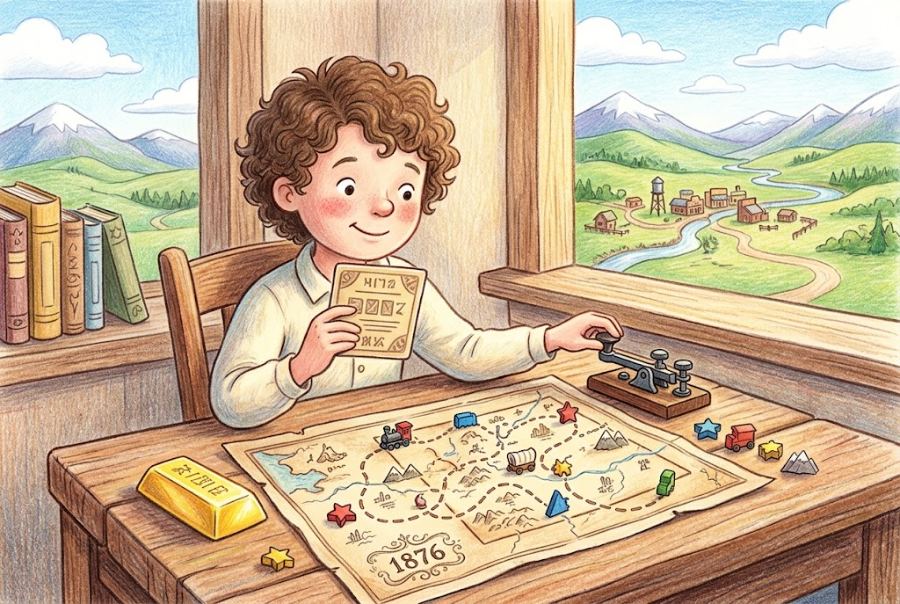
This story comes from TRACE in Colorado by T. A. Held, a time-travel series for ages 9 to 12 with a What Was Real? page in every book.
Read the book: The Wrong Choice (Book 1) · See all the TRACE in Colorado books
Previous post: What was a fancy hotel like in Denver in 1876? The Inter-Ocean and the Tremont House
Next post: For parents and teachers: a discussion guide to The Wrong Choice and life in 1876
Leave a Reply