Last updated: November 2, 2026.
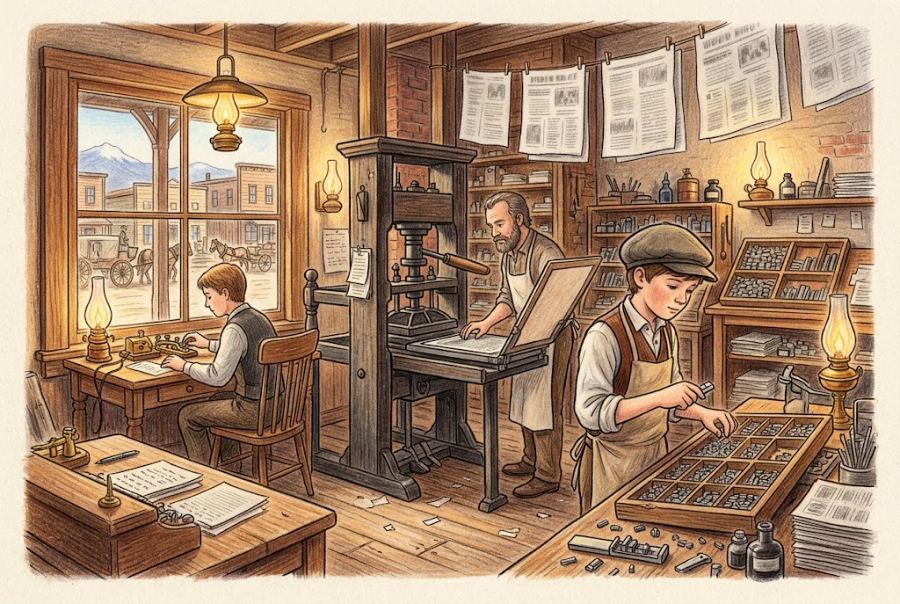
How did news travel in 1876? There were no phones, no radio and no internet. News came through telegraph wires, and the story reached readers in a newspaper that was set in type by hand. This post explains how a message crossed the country, how a newspaper was made, and the strange words printers used.
Quick facts
📰
The Rocky Mountain News
it printed its first edition on April 23, 1859, became a daily paper in 1860, and has been a morning paper since July 1870.
📡
The telegraph
it came to Denver in 1863.
📡
Morse code
American railroads and telegraph lines used American Morse, also called Railroad Morse, which is different from the International Morse code used later.
👂
Reading by ear
telegraph operators learned to read the code by sound.
💡 Did you know? A printer’s apprentice was called a printer’s devil. One of his jobs was sorting type that had been spilled and mixed up.
Timeline: how the news got faster
April 23, 1859
William Byers prints the first Rocky Mountain News.
1860
The paper begins publishing daily.
1863
The telegraph comes to Denver.
July 1870
The News becomes a morning paper.
Aug 1-2, 1876
The statehood telegram arrives and is printed.
The telegraph: messages by wire
The telegraph sent messages as electrical clicks along a wire. The telegraph came to Denver in 1863, so by 1876 news from Washington could arrive over the wire. Operators used a code of short and long signals. In the United States this was American Morse, also called Railroad Morse. It looked a bit different from the International Morse that people learn today. Some letters had gaps inside them, and a dash could be shorter than in International Morse.
Early telegraph machines made marks on paper. Operators found they could understand the code just by listening to the clicks, so the machine was redesigned into a sounder that clicked loudly with no paper tape. Experienced operators read messages by ear.
The newspaper: the Rocky Mountain News
William Byers printed the first Rocky Mountain News on April 23, 1859. It started as a weekly. It began publishing daily editions in 1860, and since July 1870 it was a morning paper. Because a morning paper is read at breakfast, the work of putting it together happened the night before.
When the telegraph brought a story, such as the news that Colorado had become a state, the newspaper printed it. The statehood telegram from Washington was dated August 1, 1876, and appeared in Colorado papers on August 2. You can read more in our post about the day Colorado became a state.
Printers and their strange words
Printing in 1876 meant arranging small metal letters, called type, into lines and pages. Printers used special words for their work:
- Pied type: when type was spilled or mixed up, printers said it was pied, or pi. Pie is an old printers’ word for letters that have been jumbled.
- The hellbox: a box where broken or used pieces of type were thrown.
- The printer’s devil: a young apprentice in a printing shop. A printer’s devil sorted type from the hellbox back into the job case, the tray where each kind of letter belongs.
It sounds like a scary job, but it was a real training job for a young person.
Fast and slow at the same time
A telegram could cross the country in a short time, but a newspaper reader still waited for the paper to be set in type and printed. News was fast compared to a letter, and slow compared to today. A story that arrived late at night might appear in the paper the next morning.
Try this at home
- How do you find out the news today? How would your day change if the only way was a paper that arrives once a morning?
- Try writing your name in clicks: one short click and one long click. What problems do you run into?
- Why do you think printers made funny names like hellbox and devil?
What is real and what is made up
The newspapers, the telegraph and the printing words above are real. The story of The Wrong Choice, which begins in Morrison in 1876, is made up. The book ends with a What Was Real? page that explains the history behind it.
This story comes from TRACE in Colorado by T. A. Held, a time-travel series for ages 9 to 12 with a What Was Real? page in every book.
Read the book: The Wrong Choice (Book 1) · See all the TRACE in Colorado books
Previous post: What was Denver like for kids in 1876? Horsecars, gas lamps and gold bars
Next post: The grasshopper plague of 1876: when swarms ate Colorado’s crops
Sources
- Rocky Mountain News, Wikipedia
- William N. Byers, Colorado Encyclopedia
- Telecommunications in Colorado, Telecommunications History Group
- American Morse code, Wikipedia
- Railroad Telegraphy Devices, Railroadiana Online
- Hellbox, Wikipedia
- Printer’s devil, Wikipedia
- Glossary of Printing and Typography, Melbourne Museum of Printing
- President Ulysses S. Grant proclaimed Colorado a state 150 years ago this week, Colorado Newsline
Leave a Reply