Author: nechamauser

  • Where the Money Went

    Where the Money Went

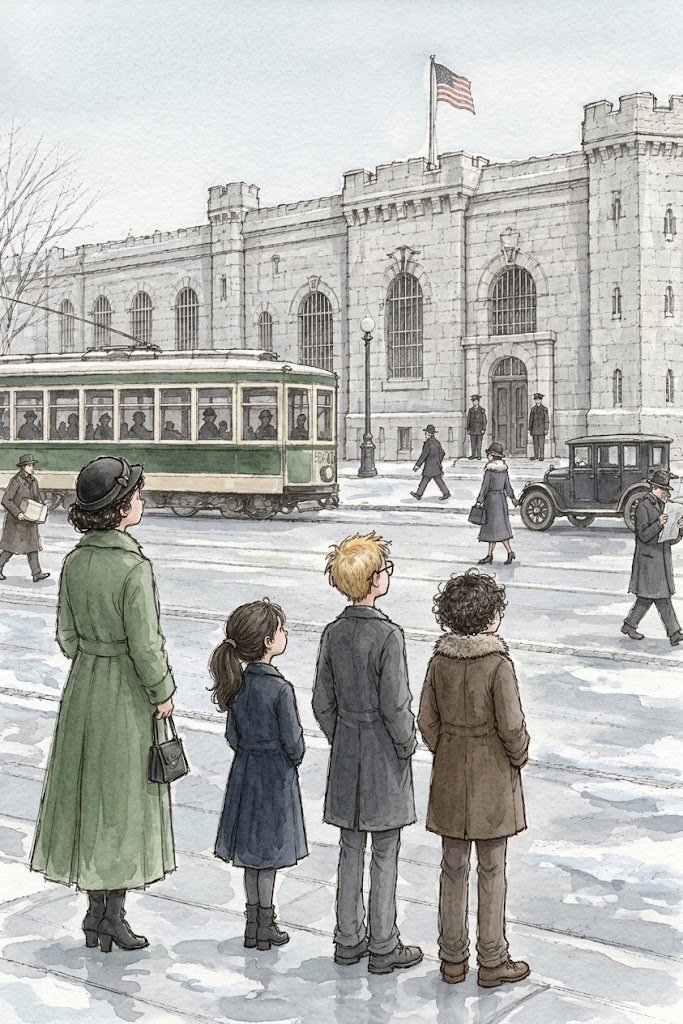
    Aurora and the kids look across a snowy Denver street with a streetcar at a big stone building

    Book 4 of 10 in TRACE in Colorado

    Where the Money Went

    The cabin door is standing wide open, and nothing is missing.

    For ages 9 to 12. Set in Colorado, 1922.

    The Story

    The stone sets Alex, Daniel, and Maya down in the cellar in December 1922. Aurora lives in the cabin alone now. She sends travelers into the past, and she keeps the stone’s secrets from everyone, even the people she cares about. She has never met the three of them, and they know more about her than she does.

    So Maya tells the whole town of Morrison that they’re Aurora’s cousins, and that their mother just had twins. That’s the easy part.

    Somebody has been watching the cabin, and he isn’t after Aurora’s money. Then, on one busy day in Denver, the journal that takes them home disappears.

    Who broke in, and what did he want? Where is the journal now? And what is the stone trying to show them this time?

    “Everybody cares where money comes from.”

    Inside the Book

    Where It Happened

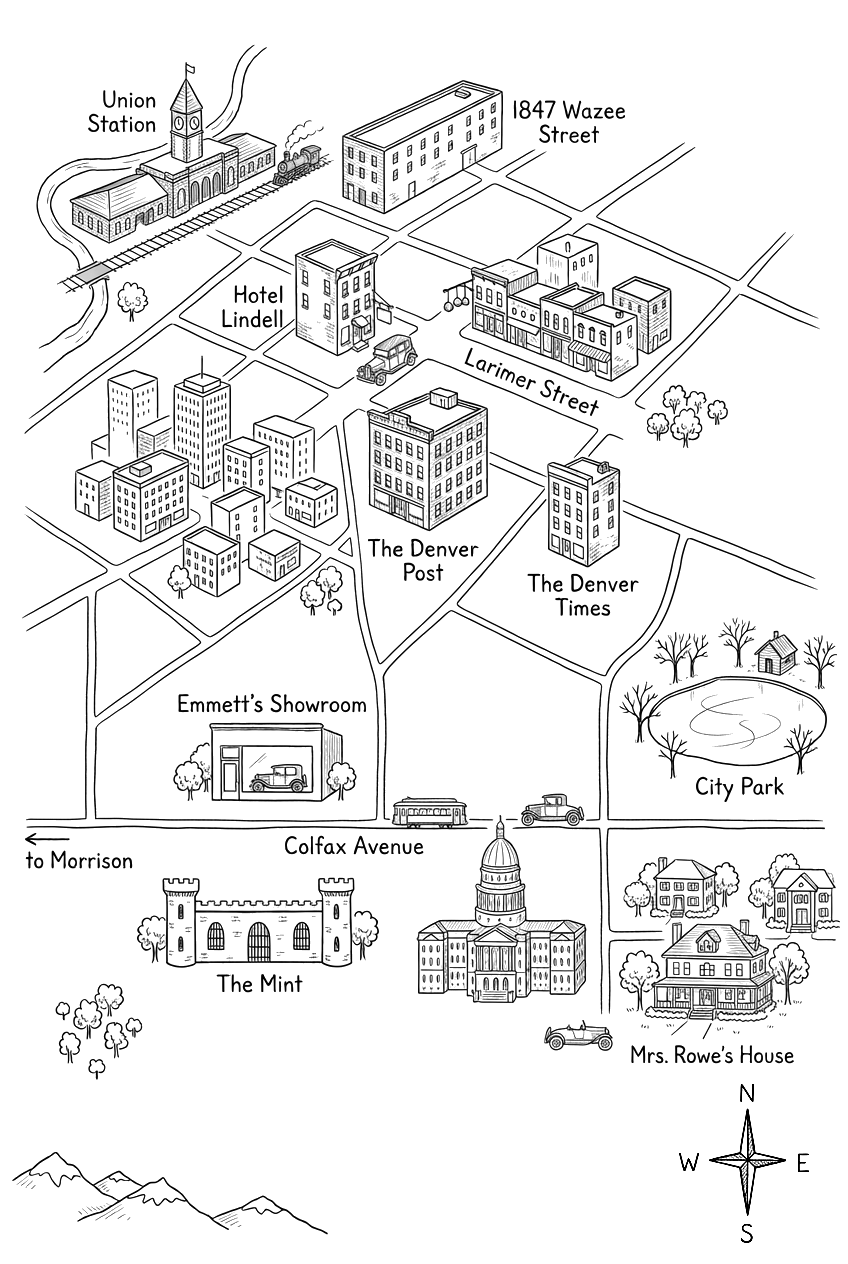
    Map for Where the Money Went: downtown Denver in 1922, with the Mint, Union Station, Larimer Street and the newspapers

    Collect Them All

    Free to download and print at home. No sign-up needed.

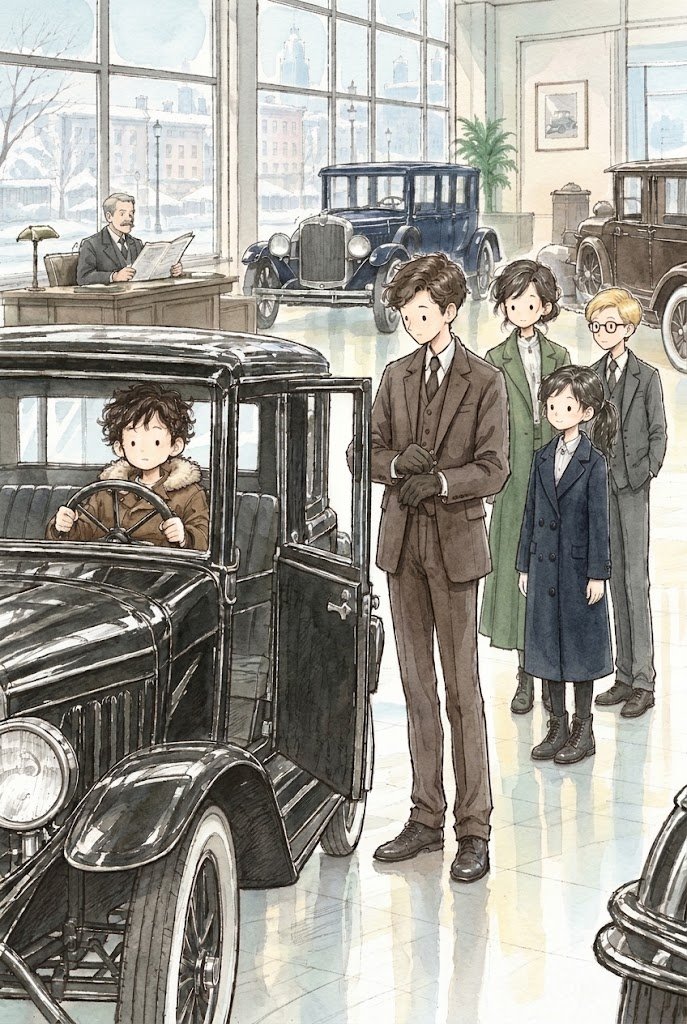
    Alex sits at the wheel of an old black car in a showroom while the others watch

    Trivia Cards

    Four trivia cards about this book. Print them in color, cut, fold, and glue.

    How do I make my trivia cards? →

    Want a printed deck? Join the waitlist →

    The passport sticker for Where the Money Went: 1922

    Passport Stickers

    The sticker for this book’s page in your Time Traveler’s Passport: 1922.

    How do I use my sticker? →

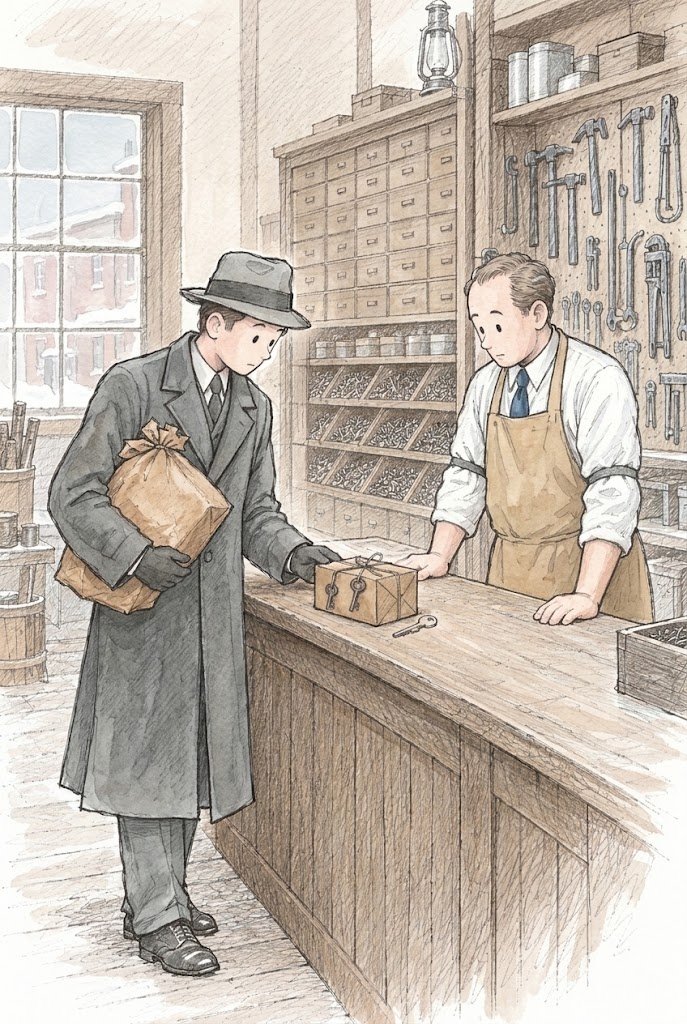
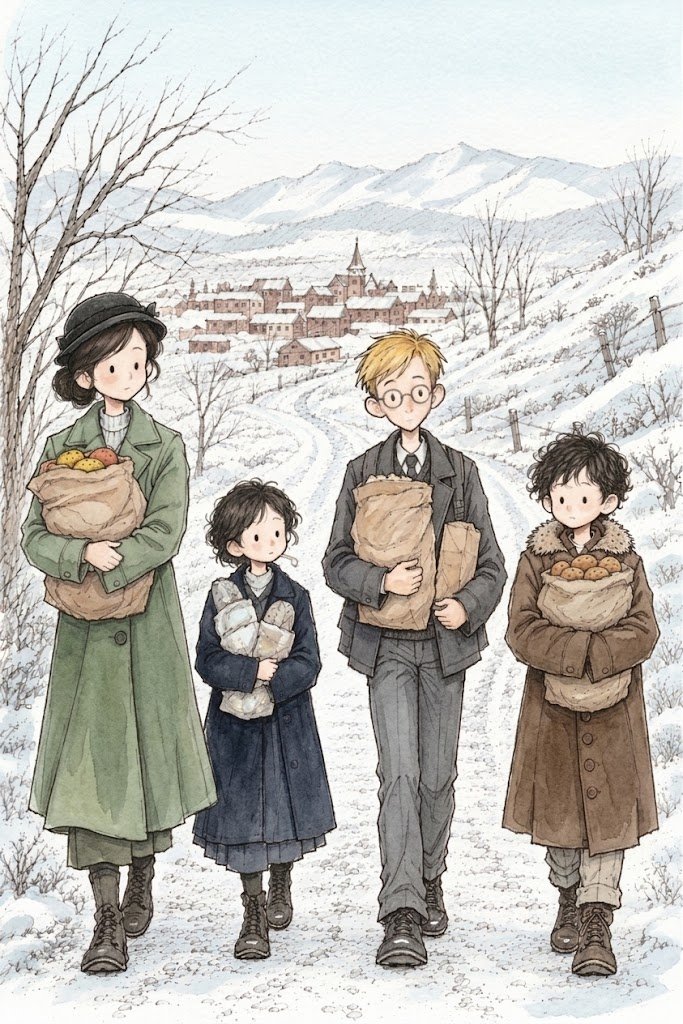
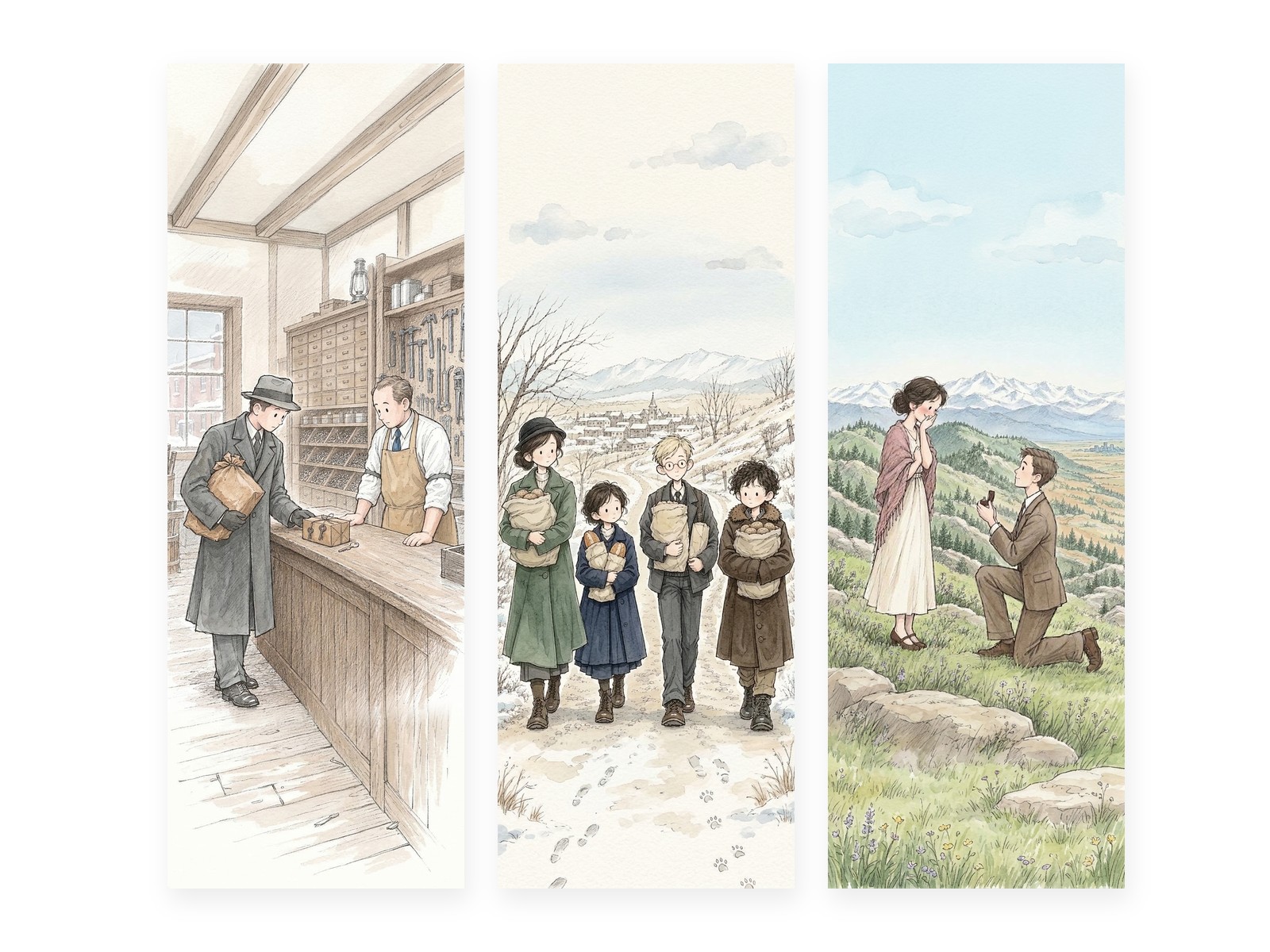
    Three bookmarks from Where the Money Went: a man ordering keys at a locksmith counter, Aurora and the kids walking through the snow with bags of bread, and Emmett proposing to Aurora on a mountain meadow

    Bookmarks

    Three bookmarks, each with a picture from the book on one side and a line from the story on the other. Print them in color, cut, fold, and glue.

    How do I make my bookmarks? →

    Aurora and the kids walk through the snow with bags of groceries, Morrison behind them

    Puzzle

    A puzzle made from a picture from this book. Coming soon.

    How do I make my puzzle? →

    Aurora and the kids walk through the snow with bags of groceries, Morrison behind them

    Time Traveler’s Passport

    The full passport booklet, with a page for every book.

    How do I make my passport? →

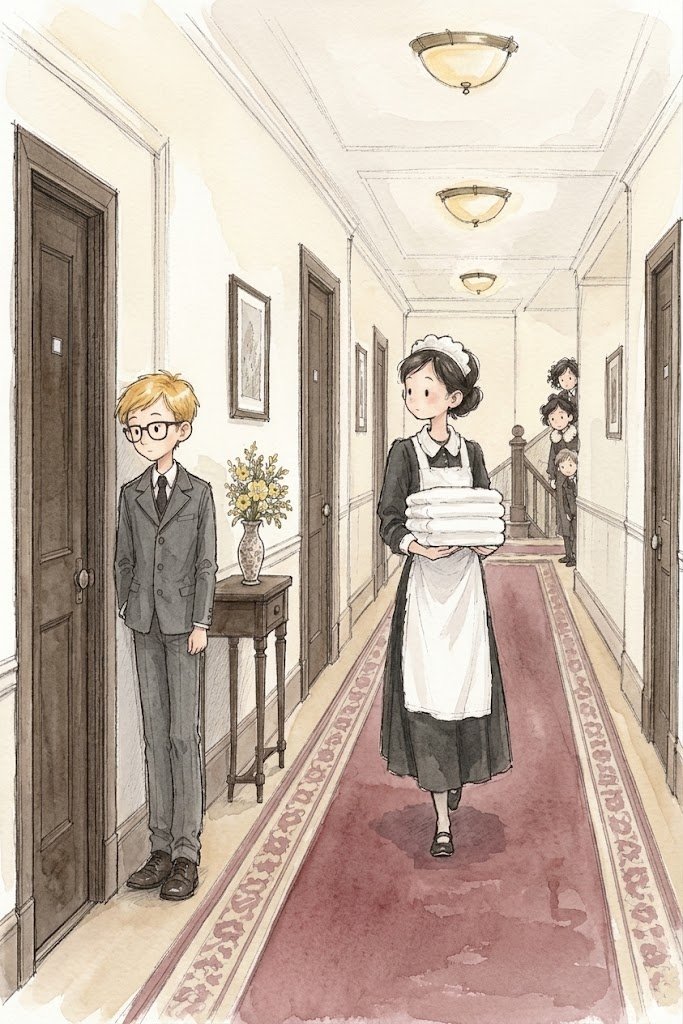
    Daniel stands in a hotel hallway as a maid walks by with a stack of towels

    Series Checklist

    All 10 books. Check off each one you read and each thing you collect.

    Want them printed? Order the printed pack in the shop.

    For Parents and Teachers

    Discussion Guide

    Questions and an activity for this book, for classrooms and book clubs. Free.

    Leave a Review

    Did your child enjoy the book? A short review on Amazon helps other families find it. Amazon only takes reviews from adults, so this one is for you.

    A Coupon for Your First Order

    Join the parents’ mailing list. We only email about new books and bonuses.

    Parents Sign-up

    Where to Buy

    Coming soon. The whole series comes out together.

    FormatStores
    PaperbackAmazon
    HardcoverAmazon
    eBookKindle
  • Tomorrow We’ll Go Home

    Tomorrow We’ll Go Home

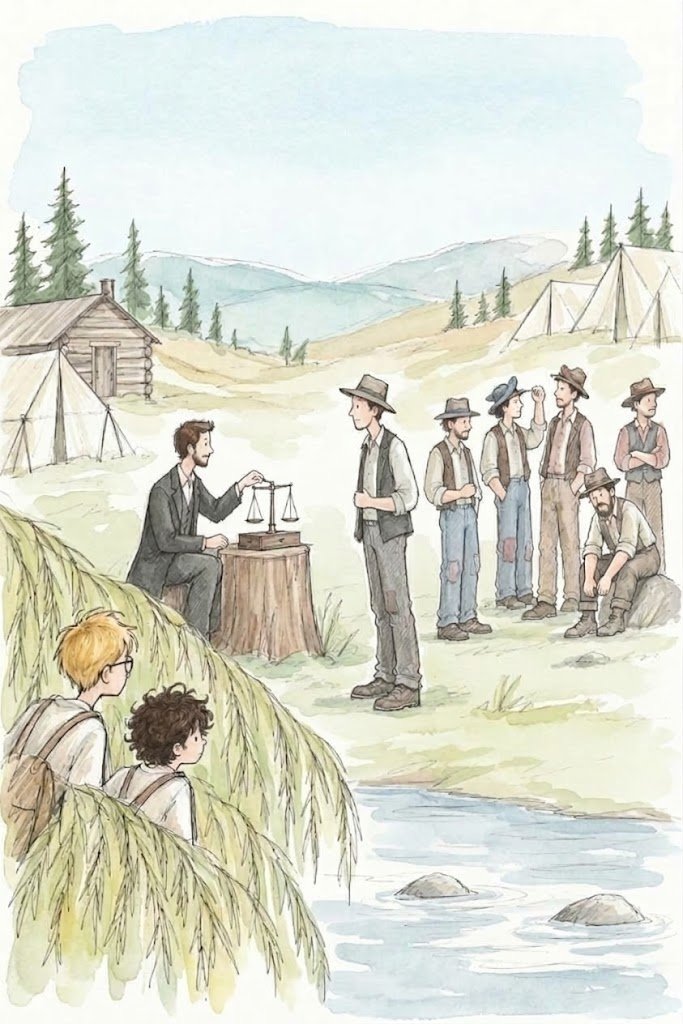
    Alex and Daniel watch from behind a willow as a man weighs gold on a scale by a creek

    Book 2 of 10 in TRACE in Colorado

    Tomorrow We’ll Go Home

    This time they have a plan. The stone has a different one.

    For ages 9 to 12. Set in Colorado, 1860.

    The Story

    Daniel has a folder of confirmed facts about the door in the cellar, and a packing list with rope, matches, and a blanket. Alex has a backpack full of snacks. They pick a year, 1859, the start of the Colorado gold rush, and they go.

    The stone sets them down a year late. Under the two triangles, somebody has written a message in chalk: DON’T DO IT. Down in Denver, a polite man is paying more for gold than anybody else in town, and nobody asks why.

    Then the stone opens again, and it doesn’t take them home.

    Who wrote the message, and who was it for? Where has the stone sent them now? And how many times can you say “tomorrow we’ll go home” before you stop believing it?

    “That’s not a rule about the door. It’s a rule about us.”

    Inside the Book

    Where It Happened

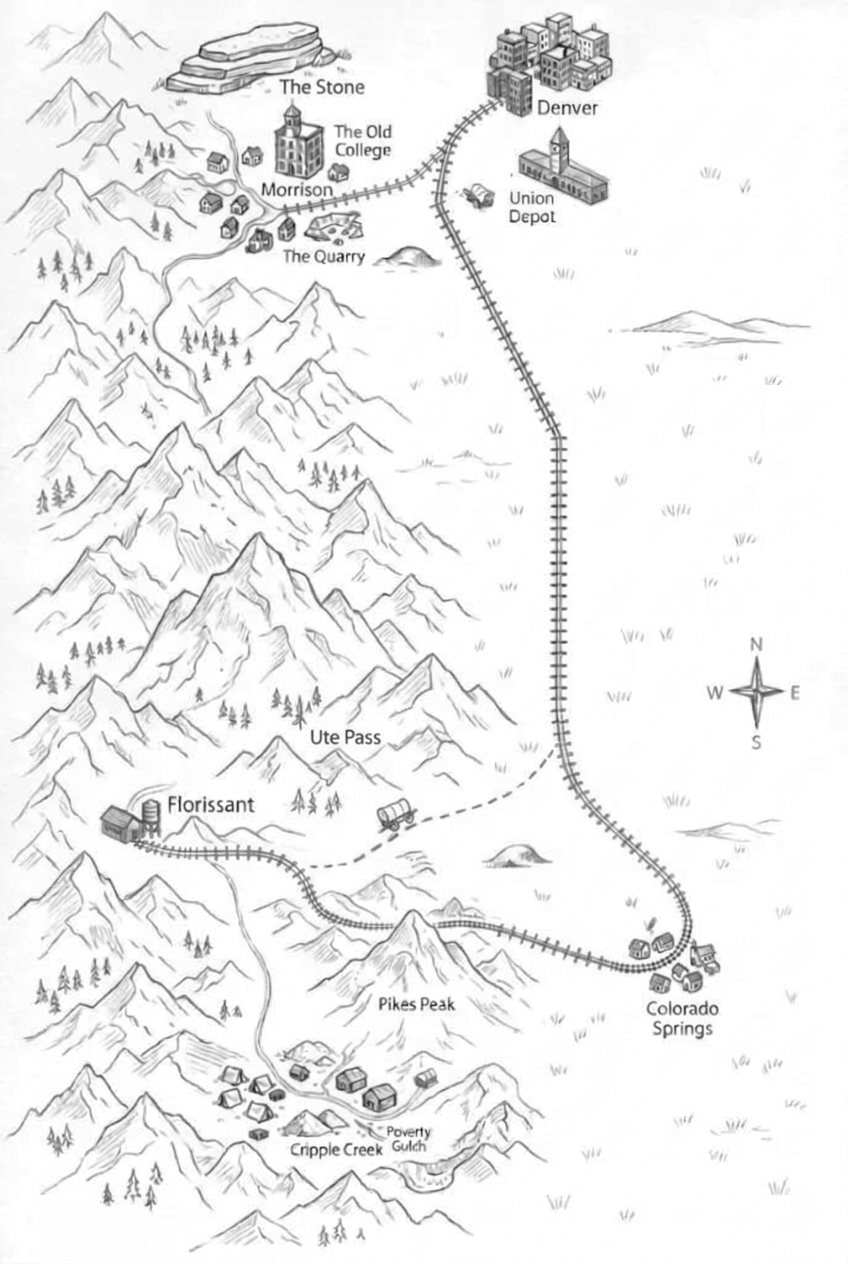
    Map for Tomorrow We'll Go Home: the stone, Morrison, Denver, the railroad south to Colorado Springs, Ute Pass, Florissant, Pikes Peak and Cripple Creek in 1891

    Collect Them All

    Free to download and print at home. No sign-up needed.

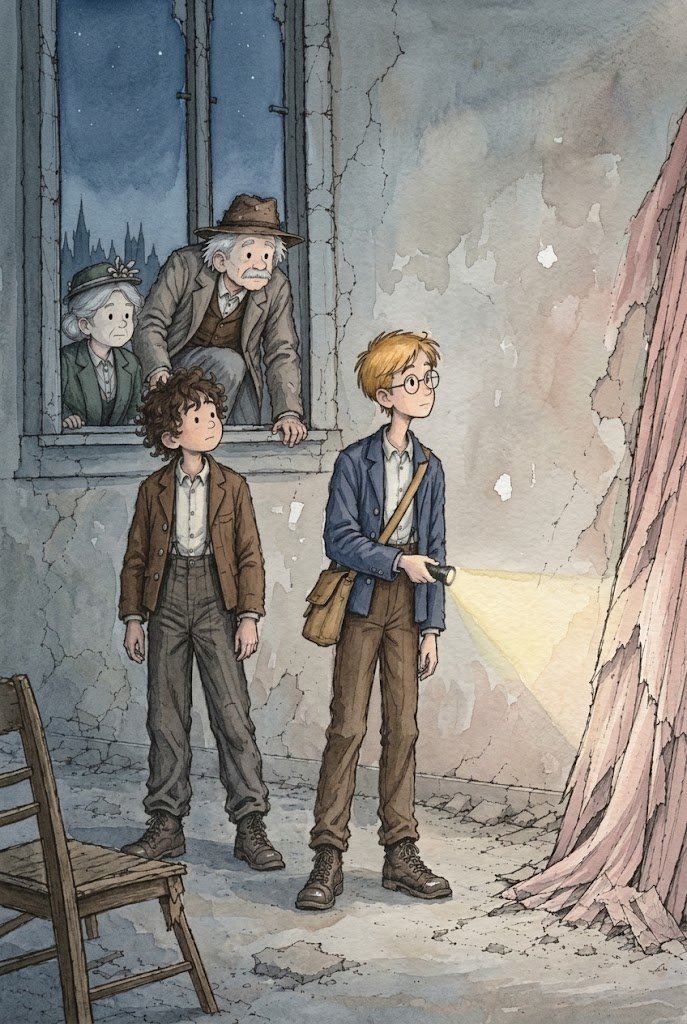
    Alex and Daniel stand in an empty hall with a flashlight while two old faces look in through the window

    Trivia Cards

    Five trivia cards about this book. Print them in color, cut, fold, and glue.

    How do I make my trivia cards? →

    Want a printed deck? Join the waitlist →

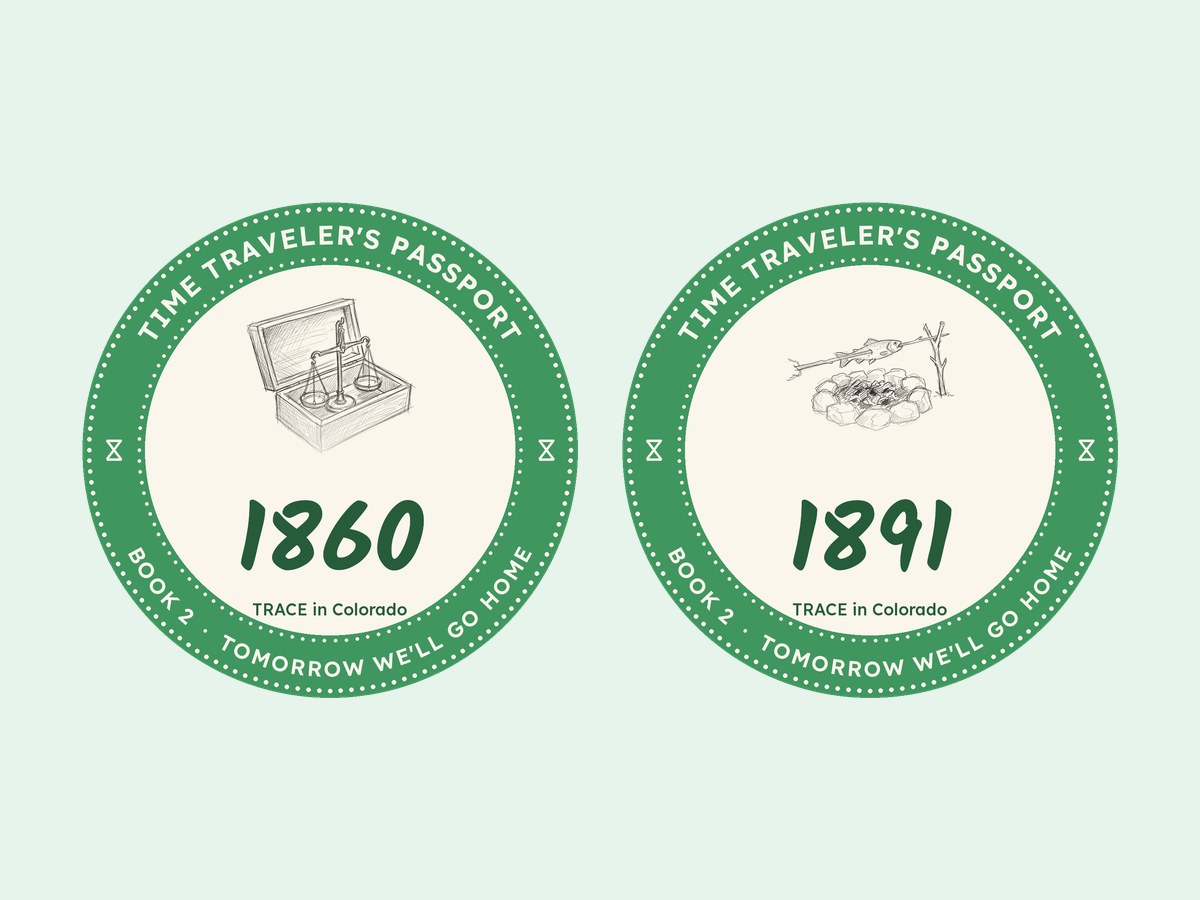
    Two round passport stickers for Tomorrow We’ll Go Home: 1860, with a gold scale, and 1891, with a campfire

    Passport Stickers

    The two stickers for this book’s page in your Time Traveler’s Passport: 1860 and 1891.

    How do I use my stickers? →

    Alex and Daniel watch from behind a willow as a man weighs gold on a scale by a creek

    Bookmarks

    Bookmarks with pictures from this book. Coming soon.

    How do I make my bookmarks? →

    A young man shows Alex and Daniel something in his hand outside the Clark, Gruber and Co. bank

    Puzzle

    A puzzle made from a picture from this book. Coming soon.

    How do I make my puzzle? →

    A young man shows Alex and Daniel something in his hand outside the Clark, Gruber and Co. bank

    Time Traveler’s Passport

    The full passport booklet, with a page for every book.

    How do I make my passport? →

    Alex and Daniel watch a horsecar pass a big station with a clock tower in Denver

    Series Checklist

    All 10 books. Check off each one you read and each thing you collect.

    Want them printed? Order the printed pack in the shop.

    For Parents and Teachers

    Discussion Guide

    Questions and an activity for this book, for classrooms and book clubs. Free.

    Leave a Review

    Did your child enjoy the book? A short review on Amazon helps other families find it. Amazon only takes reviews from adults, so this one is for you.

    A Coupon for Your First Order

    Join the parents’ mailing list. We only email about new books and bonuses.

    Parents Sign-up

    Where to Buy

    Coming soon. The whole series comes out together.

    FormatStores
    PaperbackAmazon
    HardcoverAmazon
    eBookKindle
  • Who Drew Us?

    Who Drew Us?

    Book 5 of 10 in TRACE in Colorado

    Who Drew Us?

    They’ve never been to 1877. So why are they in the drawing?

    For ages 9 to 12. Set in Colorado, 1877, with a stop in the Jurassic.

    The Story

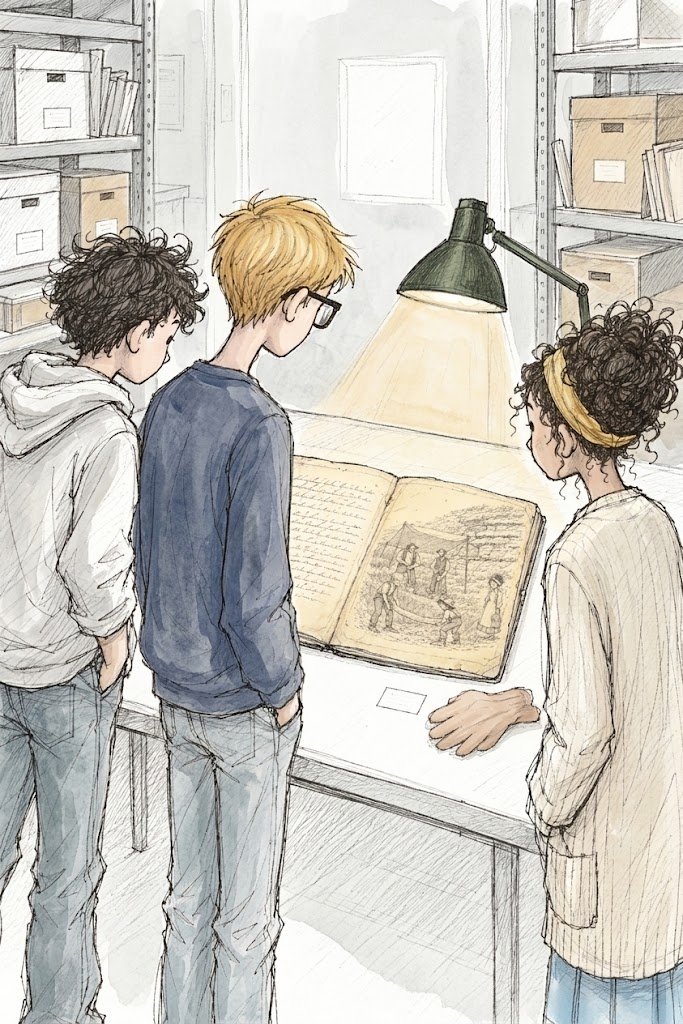
    Alex and Daniel came to Dinosaur Ridge for a field trip. Then, in a room at the museum marked STAFF ONLY, they find an old notebook open on a table. Inside it is a pencil drawing of two boys lifting a giant bone. One wears small round glasses. The other has a mess of curls. Next to them stands a girl with a bucket.

    Zoe from science class knows more about dinosaurs than the guides do. She also knows more about Alex and Daniel than they would like. When they sneak off to the cabin to find out how they got into that drawing, she follows them all the way down the cellar steps.

    Before the stone takes them anywhere near 1877, it has something much older to show them.

    In the summer of 1877, men are digging the first dinosaur bones out of a hill above Morrison, and two professors back East will pay almost anything to get them. Somebody on that hill is selling secrets. When a bone disappears, everybody looks at the three new kids from Kansas.

    Who drew them, and why? Who is selling the secrets? And what does Zoe know that she isn’t telling?

    “So you don’t know everything.”
    “Neither do you.”

    Inside the Book

    Where It Happened

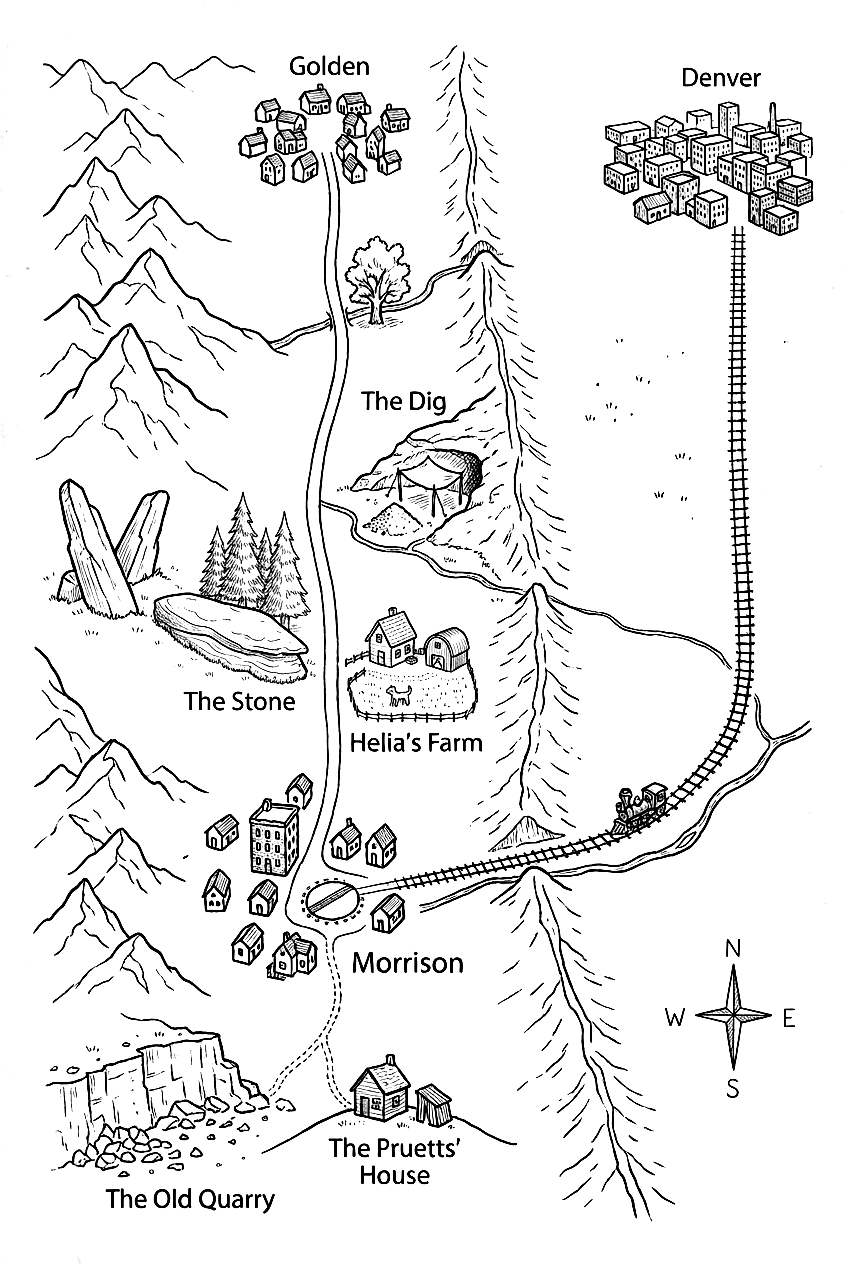
    Map for Who Drew Us?: the stone, the dig, Helia's farm, Morrison, Golden and Denver in 1877

    Collect Them All

    Free to download and print at home. No sign-up needed.

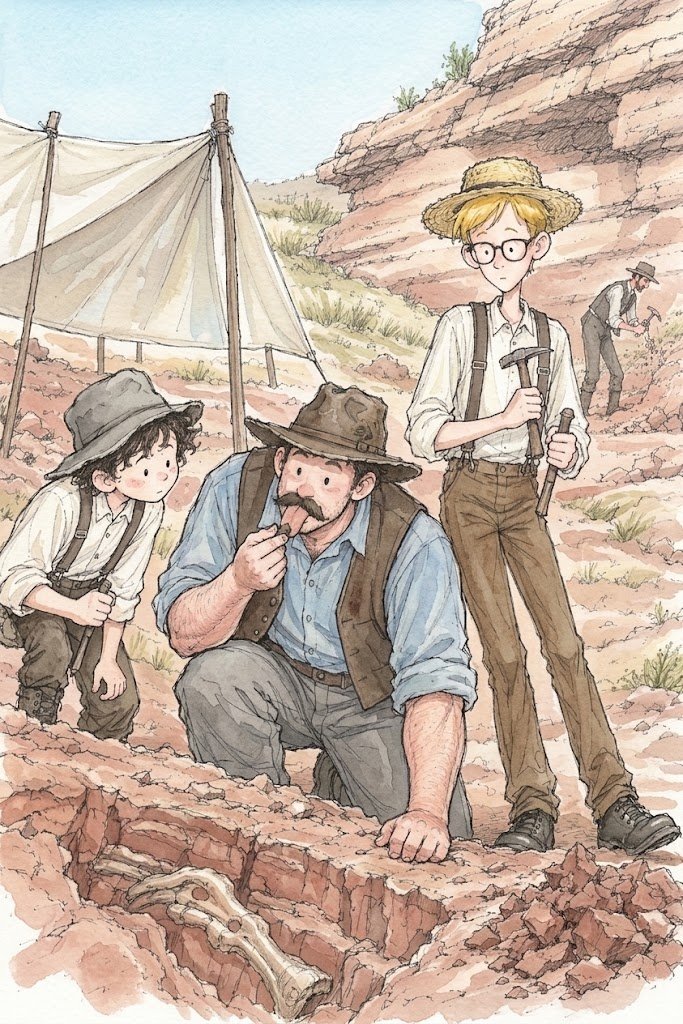
    A digger with a mustache touches a bone to his tongue while Alex and Daniel watch at the dig

    Trivia Cards

    Six trivia cards about this book. Print them in color, cut, fold, and glue.

    How do I make my trivia cards? →

    Want a printed deck? Join the waitlist →

    Two round passport stickers for Who Drew Us?: Jurassic, with a dinosaur, and 1877, with a rock hammer

    Passport Stickers

    The two stickers for this book’s page in your Time Traveler’s Passport: the Jurassic and 1877.

    How do I use my stickers? →

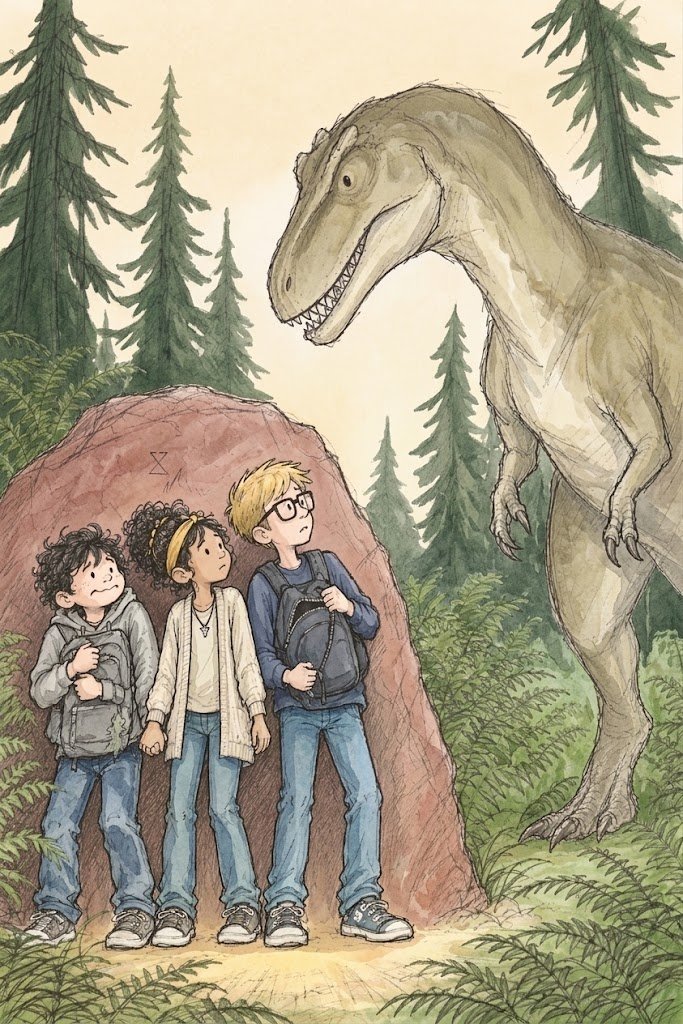
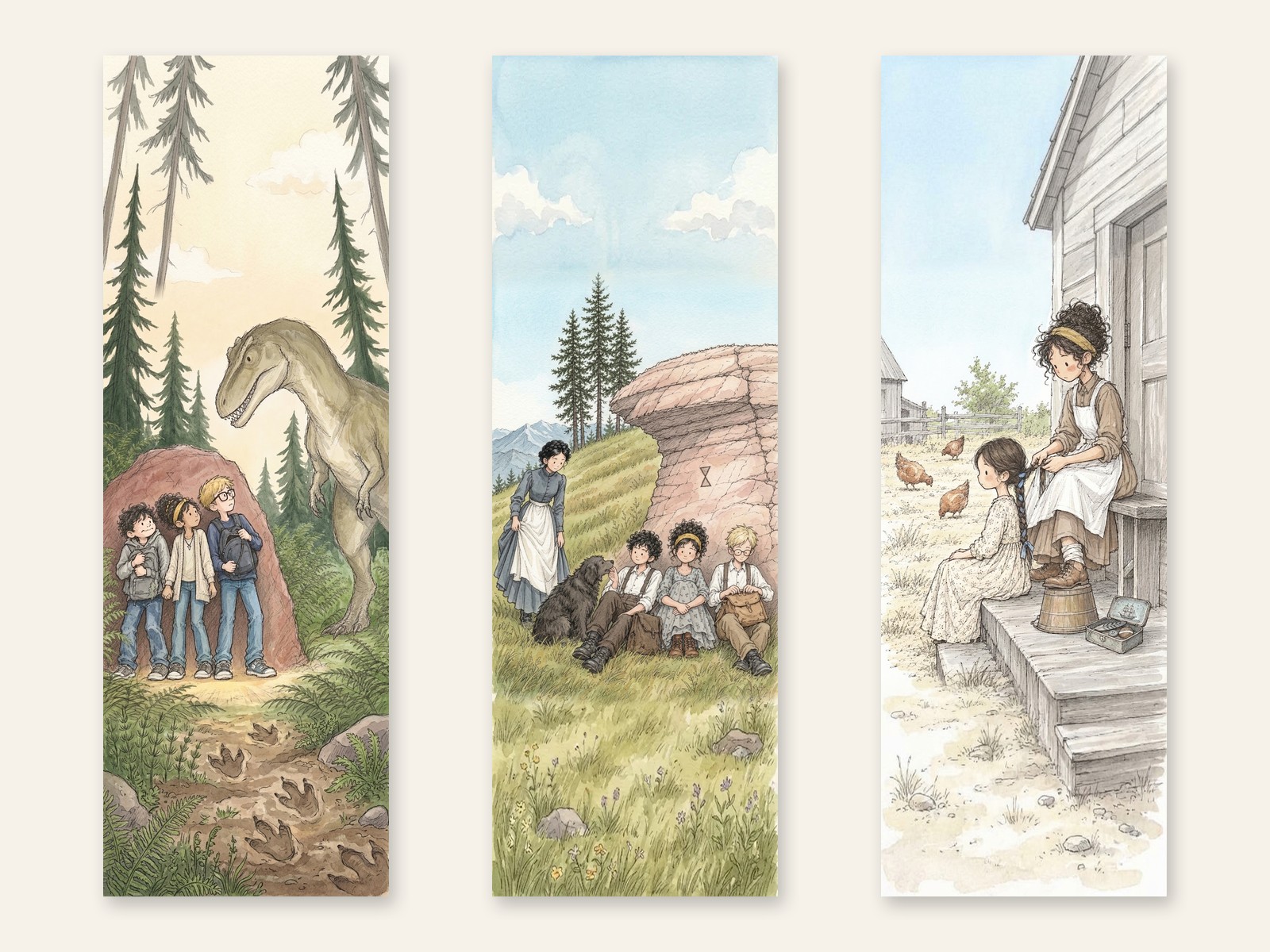
    Three bookmarks from Who Drew Us?: the kids hiding by a red rock from an Allosaurus, the kids resting by the stone with Helia, and Zoe braiding Phoebe’s hair on the porch

    Bookmarks

    Three bookmarks, each with a picture from the book on one side and a line from the story on the other. Print them in color, cut, fold, and glue.

    How do I make my bookmarks? →

    Alex, Daniel and Zoe stand by a Jurassic river with long-necked dinosaurs on the far side

    Puzzle

    A puzzle made from a picture from this book. Coming soon.

    How do I make my puzzle? →

    Alex, Daniel and Zoe stand by a Jurassic river with long-necked dinosaurs on the far side

    Time Traveler’s Passport

    The full passport booklet, with a page for every book.

    How do I make my passport? →

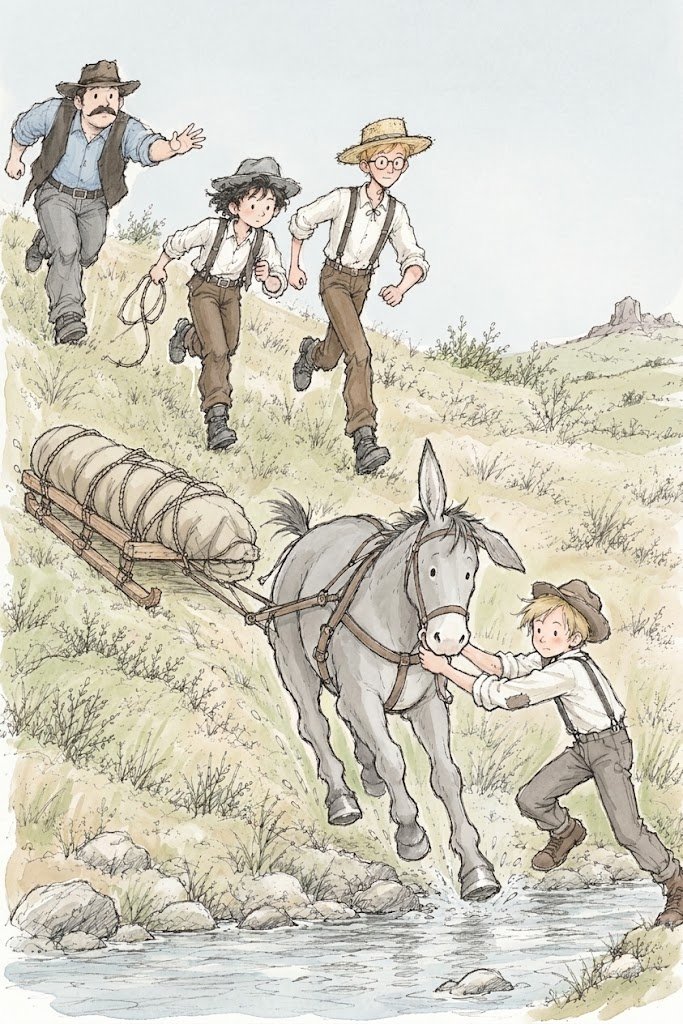
    A mule runs down to a creek dragging a sledge with a big bone, and the boys run after it

    Series Checklist

    All 10 books. Check off each one you read and each thing you collect.

    Want them printed? Order the printed pack in the shop.

    For Parents and Teachers

    Discussion Guide

    Questions and an activity for this book, for classrooms and book clubs. Free.

    Leave a Review

    Did your child enjoy the book? A short review on Amazon helps other families find it. Amazon only takes reviews from adults, so this one is for you.

    A Coupon for Your First Order

    Join the parents’ mailing list. We only email about new books and bonuses.

    Parents Sign-up

    Where to Buy

    Coming soon. The whole series comes out together.

    FormatStores
    PaperbackAmazon
    HardcoverAmazon
    eBookKindle
  • Why Was Owning Gold Against the Law in America from 1933 to 1974?

    Last updated: November 7, 2026.

    Was it ever illegal to own gold in the United States?

    Yes. For more than forty years, ordinary Americans could not simply walk into a shop and buy a gold bar. The rules began during the Great Depression and ended on December 31, 1974. This post explains what happened, in simple words.

    Quick facts

    📅

    April 5, 1933

    President Franklin D. Roosevelt signs Executive Order 6102 about gold.

    📜

    January 30, 1934

    The Gold Reserve Act becomes law.

    🪙

    Price

    Gold was worth $20.67 an ounce, then $35 an ounce after the Gold Reserve Act.

    ✅

    December 31, 1974

    Americans can own gold again.

    💡 Did you know? Some things were allowed: jewelry, gold used in industry, and rare coins that collectors wanted.

    Gold timeline

    Until 1933

    Anybody in America could buy gold

    April 5, 1933

    Executive Order 6102 is signed

    May 1, 1933

    The date by which people had to hand in extra gold

    Jan 30, 1934

    The Gold Reserve Act is signed

    Dec 31, 1974

    The rules end and private gold ownership is legal again

    Before 1933

    Until 1933 anybody in America could walk into a shop and buy gold. Before the rules changed, the official price of gold was $20.67 per ounce, and that price had stayed the same until the spring of 1933.

    What changed in 1933

    The country was in the Great Depression. On April 5, 1933, President Roosevelt signed Executive Order 6102. It forbade people to hoard gold coins, gold bars and gold certificates. People had to hand in extra gold to the government by May 1, 1933. In exchange they got paper money at the rate of $20.67 for every ounce of gold.

    What was allowed?

    The rules did not ban everything. People could keep some gold. Jewelry was one exception, and so were rare coins that collectors wanted. Gold could also be used in industry, for things like dental work, jewelry and electronics. The limit for gold coins and certificates was $100, which is about 5 troy ounces.

    The Gold Reserve Act

    In January 1934 the Gold Reserve Act made the rules permanent. The government also changed the price of gold from $20.67 to $35 an ounce. This made gold more valuable in dollars and lowered the gold value of the dollar. The Federal Reserve gives the new price as $35 per ounce.

    When did it end?

    Private ownership of gold became legal again on December 31, 1974. A law that took effect on that day repealed the old rules. From then on, Americans could buy and sell gold freely again.

    The law that ended the old rules is called the International Development Association Appropriations Act of 1975. The Federal Reserve explains that Americans have been able to own gold freely and legally since 1974, when President Gerald Ford signed an act of Congress that allowed people in the United States to own and deal in gold. So the ban lasted from 1933 until the very last day of 1974, which is a little more than forty-one years.

    Why does this matter for stories?

    In practice this means that between 1933 and 1974, a person could not openly buy or sell a gold bar. That is a good detail to remember when you read about money in the 1940s, 1950s or 1960s. A character in a story from those years cannot just pay with gold the way a character in 1876 could. The history of money is full of small facts like this.

    What is real and what is made up

    Real: the dates, the prices, the limits and the exceptions in this post.

    Made up: the characters and the plot of Behind the Wire. The book follows the real rules of its time.

    This story comes from TRACE in Colorado by T. A. Held, a time-travel series for ages 9 to 12 with a What Was Real? page in every book.

    Read the book: Behind the Wire (Book 6) · See all the TRACE in Colorado books

    Previous post: Cooper Hill and Tennessee Pass: skiing in 1944

    Next post: Camp Hale and Cold War quiz for kids

  • Camp Hale and Cold War Quiz for Kids: Spies, Ski Soldiers and Escapes

    Last updated: November 7, 2026.

    How much do you know about Camp Hale, the Cold War and the ski soldiers of Colorado?

    Here are nine questions. Pick A, B or C in your head, then click the question to see the answer. Every answer is a true fact, and you can read more in the other posts in this series.

    Quick facts

    🎯

    Questions

    Nine, each with three choices: A, B or C.

    🧠

    Level

    Made for kids about 9 to 12 and their families.

    📚

    Topics

    A secret camp, October 1962, ski soldiers and a prisoner escape.

    🤝

    Play

    Take turns reading the questions aloud and keep score.

    💡 Did you know? Camp Hale is high in the Rocky Mountains, about 9,200 feet above sea level, which is why its winters were so long and snowy.

    How to play

    Read each question and choose your answer. Click the question to open the answer. One point for each right answer. Eight or nine points means you are a Camp Hale expert.

    The nine questions

    1. Who did the CIA secretly train at Camp Hale from 1958 to 1964? A) Astronauts B) Men from Tibet C) Firefighters

    The answer is B, men from Tibet. They hoped to go home and fight for Tibet.

    2. What did the Tibetans call Camp Hale? A) Dumra, which means garden B) Snow Valley C) The Ranch House

    The answer is A. The Tibetans gave the camp a name of their own. The CIA called it The Ranch.

    3. What were people near Camp Hale told the secret camp was doing? A) Building a ski area B) Growing potatoes C) Atomic tests

    The answer is C. It was a cover story, and the truth came out only in 1973.

    4. In October 1962, what did American spy planes find in Cuba? A) Soviet missiles B) A sunken ship C) A gold mine

    The answer is A. They were close enough to reach Washington, D.C.

    5. What did a lift ticket at Vail cost when it opened in December 1962? A) Fifty cents B) Fifty dollars C) Five dollars

    The answer is C. A lift ticket cost $5 that season.

    6. What did Camp Hale soldiers call their coal-smoke cough? A) The Pando Hack B) The Mountain Sneeze C) The Leadville Wheeze

    The answer is A. The smoke got stuck in the valley all winter.

    7. Cooper Hill, where the ski soldiers trained, had the country’s longest what? A) Ski jump B) T-bar lift C) Sled run

    The answer is B. It pulled the soldiers up the hill on a cable.

    8. What did Dale Maple buy so that a German prisoner could dress as a woman? A) A yellow sweater and scarf B) A long red wig C) A feathered hat

    The answer is A. The other prisoner was going to pass as an ordinary man.

    9. Where were Dale Maple and the two prisoners caught? A) In Canada B) In Denver C) At the Mexican border

    The answer is C. Their old car broke down, so they walked across the border. A Mexican customs inspector caught them.

    Want more?

    Read the longer stories behind these questions: the post about Camp Hale and the ski soldiers, the one about the CIA and the Tibetans, and the one about the prisoner escape of 1944.

    What is real and what is made up

    Real: every answer in this quiz comes from real history.

    Made up: the characters and the plot of Behind the Wire, which are not part of this quiz.

    This story comes from TRACE in Colorado by T. A. Held, a time-travel series for ages 9 to 12 with a What Was Real? page in every book.

    Read the book: Behind the Wire (Book 6) · See all the TRACE in Colorado books

    Previous post: Why owning gold was against the law, 1933 to 1974

    Next post: For parents and teachers: a discussion guide for Behind the Wire

  • For Parents and Teachers: Talking With Kids About the Cold War (Behind the Wire Guide)

    Last updated: November 7, 2026.

    How do you talk with a 10-year-old about the Cold War, secrets and prisoners of war?

    Behind the Wire is Book 6 of The Riddle America Cannot Explain: TRACE in Colorado, a time-travel series for ages 9 to 12. It is set in the mountains of Colorado in 1962 and 1944. This guide gives families and teachers questions to talk about after reading, words to learn, and links to free downloads.
    Quick facts

    📖

    The book

    Behind the Wire is a time-travel adventure set near Leadville and Camp Hale in October 1962 and February 1944.

    🧒

    Ages

    Written for ages 9 to 12.

    🗂️

    Every book has

    A What Was Real? page that separates true history from the invented story.

    🎁

    Free downloads

    Bookmarks, a puzzle, trivia cards and a time-traveler passport.

    💡 Did you know? The real history behind this book includes a secret CIA camp, a Cold War crisis, ski soldiers and a prisoner escape. Each can be a small research project for a class.

    About the book (no spoilers)

    In Behind the Wire, Maya will not forgive the boys for going on a trip without her, so this time the three friends go together. The time-travel adventure takes them to the mountains in 1962, when the Army is guarding a secret behind a plain wooden fence, and then to the same valley eighteen years earlier, in winter, when the camp is full of ski soldiers and German prisoners. The story is made up. The setting and the history are real.

    Questions to talk about

    • In October 1962 the whole country listened to the radio and waited. What do you think it feels like to wait for news that could change everything?
    • The camp in 1962 was a secret. Is it ever right to keep a secret from your neighbors? Who decides?
    • The soldiers of the 620th were not allowed to carry weapons because the Army did not fully trust them, even though nothing was proved. Is it fair to distrust people without proof?
    • How do you check whether a story about the past is true? Which sources would you trust?
    • Why do you think the author wrote a What Was Real? page at the end?
    • If you could ask one person from 1944 one question, who would it be and what would you ask?

    New words to learn

    • Cold War: a long period of tension between the United States and the Soviet Union that did not become a direct war.
    • Quarantine: in October 1962, a plan to stop and check ships heading to Cuba.
    • Prisoner of war: a soldier captured by the enemy during a war.
    • T-bar: a ski lift that pulls skiers uphill on a cable.
    • Cover story: a made-up explanation used to hide the truth.
    • WAC: a member of the Women’s Army Corps.
    • Pando Hack: the cough soldiers got from coal smoke trapped in the Camp Hale valley.

    Short research projects

    Pick one project. Find the dates of the Cuban Missile Crisis, October 16 to 28, 1962. Or read about Camp Hale and make a map of the camp, Pando, Leadville and Red Cliff. Or learn how ski areas such as Vail began. A good rule for any project is to write down where each fact came from, just like the Sources list at the bottom of every post here.

    Free downloads

    The TRACE in Colorado site has free downloads for each book. Here are the instruction pages: bookmarks, the puzzle, trivia cards and the time-traveler passport.

    More to read in this series

    Start with the quiz, Camp Hale and Cold War quiz, or read about the Cuban Missile Crisis in October 1962.

    What is real and what is made up

    Real: Camp Hale, the 620th, the Cuban Missile Crisis, the CIA camp, Vail and the ski soldiers.

    Made up: the children, their families, the plot and all the dialogue in Behind the Wire. Only the setting and the history are real.

    This story comes from TRACE in Colorado by T. A. Held, a time-travel series for ages 9 to 12 with a What Was Real? page in every book.

    Read the book: Behind the Wire (Book 6) · See all the TRACE in Colorado books

    Previous post: Camp Hale and Cold War quiz for kids

  • October 1962: The Cuban Missile Crisis and What Was Happening in Colorado

    Last updated: November 7, 2026.

    What was the Cuban Missile Crisis, and how did it feel to be a kid in 1962?

    For thirteen days in October 1962, the United States and the Soviet Union came closer to a nuclear war than ever before. People across the country listened to the radio and watched the news and waited. This post explains what happened, and what else was going on in Colorado that same month.

    Quick facts

    📅

    Dates

    October 16 to October 28, 1962.

    📻

    The big speech

    President Kennedy spoke to the nation on radio and TV on Monday, October 22, 1962, at 7 p.m. Eastern time.

    🚢

    The plan

    A quarantine, which meant ships carrying offensive weapons to Cuba would be stopped.

    ✅

    The end

    On Sunday, October 28, the Soviet leader Khrushchev agreed to remove the missiles.

    💡 Did you know? The missiles Kennedy talked about could reach Washington, D.C., the Panama Canal, Cape Canaveral and Mexico City. The longer-range ones could reach as far north as Hudson Bay in Canada and as far south as Lima, Peru.

    The thirteen days

    Oct 16

    The crisis begins

    Mon Oct 22

    Kennedy tells the country about the missiles in Cuba

    Wed Oct 24

    The naval quarantine takes effect

    Sat Oct 27

    A second letter from Khrushchev is broadcast on Radio Moscow

    Sun Oct 28

    Khrushchev agrees to remove the missiles

    What happened?

    American spy planes found Soviet missiles on the island of Cuba. On Monday, October 22, President Kennedy told Americans about the problem on radio and television. He said the government had watched the Soviet buildup closely and would begin a strict quarantine on all offensive military equipment shipped to Cuba.

    The word “quarantine”

    A quarantine usually means keeping sick people apart. Here it meant that the Navy would stop and check ships heading to Cuba. It took effect on the morning of Wednesday, October 24. That day, Soviet ships heading for Cuba stopped or turned back.

    The second letter

    On the morning of Saturday, October 27, Radio Moscow broadcast a second letter from Khrushchev. It offered to take the missiles out of Cuba if the United States took its missiles out of Turkey. The next morning, Sunday, October 28, Khrushchev announced that the missile bases in Cuba would be taken apart and the missiles sent home.

    What else was happening in Colorado?

    We have not found a record of how people in Leadville reacted that week, so we will not guess. But here is what we do know about the Colorado mountains in autumn 1962:

    • Crews were finishing the new ski village of Vail. It opened on December 15, 1962, and a lift ticket cost $5.
    • Not far from Camp Hale, the CIA’s secret Tibetan training camp was still running. Its fourth and last group of trainees arrived in October 1962.
    • The Army still used Camp Hale a little, for winter training, and formally closed it in 1965.

    Why do we still talk about it?

    The crisis shows how close two countries can come to war, and how it ended when the Soviet leader agreed to take the missiles away. Kennedy’s speech was broadcast on both radio and television, so families all over the country could hear the same words at the same time. Old recordings and the full text of the speech are online, so you can read what people heard that evening.

    What is real and what is made up

    Real: the dates, the speeches, the quarantine, the letters, Vail’s opening and the CIA camp.

    Made up: the characters and the plot of Behind the Wire. The book uses the real week as its background.

    This story comes from TRACE in Colorado by T. A. Held, a time-travel series for ages 9 to 12 with a What Was Real? page in every book.

    Read the book: Behind the Wire (Book 6) · See all the TRACE in Colorado books

    Previous post: The Tibetans who trained at Camp Hale

    Next post: Vail in 1962: a ski village being built

  • The CIA, the Tibetans and Camp Hale: A Secret Colorado Story

    Last updated: November 7, 2026.

    Did the CIA really train Tibetan soldiers in Colorado?

    Yes. For several years after World War II ended, the old Camp Hale valley held a secret. From summer 1958 to 1964 the CIA trained men from Tibet there. Most people who lived nearby had no idea. This post tells the true story in simple words.

    Quick facts

    📅

    Years

    Summer 1958 to 1964.

    🏷️

    Names

    The CIA called the camp The Ranch. The Tibetans called it Dumra, which means garden.

    👥

    Trainees

    About 259 men trained there.

    🤫

    Cover story

    People were told it was a place for atomic tests. The truth came out in 1973.

    💡 Did you know? When a snowstorm delayed a bus of trainees at Peterson Field in Colorado Springs in December 1961, soldiers made the civilians at the airfield swear not to talk about what they had seen.

    Secret camp timeline

    Summer 1958

    Training begins at Camp Hale

    July 1959

    A Denver Post story about an atom unit making tests near Leadville fits the cover story

    Dec 1961

    A bus of trainees is held at Peterson Field

    Oct 1962

    The fourth and last group arrives

    1964

    The training ends

    1973

    The secret becomes public

    Why Tibetans?

    After China took control of Tibet, some Tibetans wanted to go home and fight for their country. The CIA agreed to train them far from home, in a place where nobody would ask questions. Most of the trainees were Khampa fighters from the region of Kham, recruited among Tibetan refugees in India. Tibet’s mountains are much higher than the Rockies, and Camp Hale sits at about 9,200 feet.

    What did they learn?

    The men learned guerrilla warfare, radio, secret codes, survival skills, map and compass reading, weapons and hand-to-hand fighting. They came in four groups. The fourth group arrived in October 1962. New trainees were moved at night and usually arrived before dawn, so that nobody would see them.

    Life at Dumra

    The trainees were not only studying. In their free time they played volleyball and watched Western movies. Their favorite film was The King and I. On Saturday nights they cooked Tibetan food such as momo and shabaley. One trainee remembered watching skiers on the slopes in winter and hearing the freight train’s whistle every evening.

    A camp hidden in plain sight

    The fence around the compound was only a plain wooden one, meant to keep out the odd hiker or miner. The cover story worked. The camp was a secret even to people who lived nearby. The secret nearly slipped out in December 1961. A bus of trainees, delayed by a snowstorm, reached the airfield at Colorado Springs after the staff had arrived. Soldiers held the civilians in offices and hangars until they raised their hands and swore not to talk about it, and the New York Times dropped the story. In 1973 the author David Wise wrote about it in a book called The Politics of Lying, and the world learned what had happened in the Colorado mountains.

    The shepherd and the sheep

    A local shepherd led his sheep past the compound every year, so the gate was shut tight while he went by. One year two Tibetans took a sheep, roasted it and carried it inside. The shepherd was angry and not satisfied. Nobody knows which year it happened.

    The camp today

    In 2024 a scholar connected with the University of Colorado Boulder located the exact site of the secret training camp. According to that report, the CIA and the trainees reached it from State Highway 91, near the Climax mine at Fremont Pass, and the entrance was closely guarded.

    What is real and what is made up

    Real: the CIA camp, the name Dumra, the cover story, the four groups, the volleyball, the movies and the food.

    Made up: the characters and the plot of the book Behind the Wire. The book uses the real camp and the real week as its setting, and its What Was Real? page explains which parts are history.

    This story comes from TRACE in Colorado by T. A. Held, a time-travel series for ages 9 to 12 with a What Was Real? page in every book.

    Read the book: Behind the Wire (Book 6) · See all the TRACE in Colorado books

    Previous post: The Camp Hale prisoner escape of February 15, 1944

    Next post: October 1962: the Cuban Missile Crisis and Colorado

  • Cooper Hill and Tennessee Pass: Where Ski Soldiers Trained in 1944

    Last updated: November 7, 2026.

    Where did the Army’s ski soldiers train in Colorado, and can you ski there today?

    The answer is Cooper Hill, on top of Tennessee Pass. In 1944 it was a training slope for the soldiers of the 10th Mountain Division. Today it is a ski area called Ski Cooper. This post tells the story of the hill, the pass and the railroad that made them important.

    Quick facts

    ⛰️

    The pass

    Tennessee Pass is 10,424 feet above sea level. U.S. Highway 24 crosses it between Leadville and the Eagle River valley.

    ⛷️

    The ski area

    Opened in 1942 as the Cooper Hill Ski Area. Today it is called Ski Cooper and is owned by Lake County.

    🚠

    The T-bar

    Cooper Hill had the longest T-bar lift in the country.

    🚂

    The railroad

    The hill is a short distance from Camp Hale, which was built at the railroad stop of Pando.

    💡 Did you know? In March 1944 the 10th Mountain Division began its biggest training exercise, called the D-Series maneuvers. Three months later it left Colorado for Texas.

    Tennessee Pass timeline

    1881

    A narrow-gauge railroad is built over Tennessee Pass

    1890

    A standard-gauge line and a tunnel under the pass are built

    1942

    The Army chooses Cooper Hill as a training site

    March 26, 1944

    The D-Series maneuvers begin

    June 1944

    The division leaves for Camp Swift, Texas

    1945

    A newer tunnel replaces the old one

    Why Cooper Hill?

    In 1942 the U.S. Army needed a place where soldiers could learn to ski and fight in the snow. It chose Cooper Hill at Tennessee Pass and Camp Hale was being built nearby, at the railroad stop of Pando. Today Ski Cooper is described as one of the oldest ski areas in Colorado.

    How a T-bar works

    A T-bar lift pulls skiers uphill. Each skier stands with a bar shaped like an upside-down T behind their legs and is pulled along the snow by a moving cable. Cooper Hill’s T-bar was the longest in the country when the soldiers trained there. It carried the soldiers up the mountainside so they could ski down again and again.

    The pass and the railroad

    Tennessee Pass is a gap in the Continental Divide north of Leadville. The Denver and Rio Grande Western Railroad built a narrow-gauge line over it in 1881. In 1890 a standard-gauge line and a tunnel about 200 feet below the summit were built. The tunnel was replaced by a newer one in 1945. In recent times it was the highest active mainline railroad pass in the United States. The line is now out of use.

    The big exercise

    The D-Series maneuvers began on March 26, 1944. They came shortly before the 10th Mountain Division left Colorado for Camp Swift, Texas, in June 1944. One source gives an earlier date, but June 1944 is the date used here.

    Cooper Hill after the war

    Ski Cooper opened to the public after the war. It still holds a Memorial Day celebration for the veterans of the 10th Mountain Division. A memorial to the division stands at the top of Tennessee Pass.

    Visiting today

    If you are driving in Colorado you can see Tennessee Pass on U.S. Highway 24. The road is generally open all year round and closes only during severe winter storms. Always check road and ski conditions before you travel.

    What is real and what is made up

    Real: Tennessee Pass, Cooper Hill, the T-bar, the D-Series, the railroad and the memorial.

    Made up: the children and the plot of Behind the Wire. The real hill and the real history are the setting for the story.

    This story comes from TRACE in Colorado by T. A. Held, a time-travel series for ages 9 to 12 with a What Was Real? page in every book.

    Read the book: Behind the Wire (Book 6) · See all the TRACE in Colorado books

    Previous post: Vail in 1962: a ski village being built

    Next post: Why owning gold was against the law, 1933 to 1974

  • Cold War Books for Kids: 1962, the Cuban Missile Crisis and Camp Hale

    Last updated: November 7, 2026.

    Are there good books for kids about 1962, the Cuban Missile Crisis and the Cold War? There are, and here are four. Three are well-known stories about growing up in 1962. The fourth is a time-travel adventure set in Colorado.

    Every book here is for kids who like history served as a story. Each has a short card, a closer look underneath, and a quick chooser at the bottom.

    What these books have in common

    All four are set in or around October 1962, when the United States and the Soviet Union came close to war over missiles in Cuba. Three follow kids at home, at school and with their families. Behind the Wire goes to the mountains of Colorado and to Camp Hale, a real army camp, and its What Was Real? page explains the history.

    The books

    1. Countdown

    📖 Documentary novel · ✍️ Deborah Wiles · Scholastic Press, 400 pages

    Eleven-year-old Franny lives in Maryland in 1962. Her father is a pilot, and the fear of the Cuban Missile Crisis is everywhere.

    👍 Good for kids who like to see the 1960s through pictures, songs and news clippings as well as a story.

    More about Countdown

    Publishers Weekly calls Countdown a “documentary novel.” It is set in Maryland during the Cuban Missile Crisis. Franny is a middle child, and her father, like the author’s own father, is a pilot stationed at Andrews Air Force Base. The book is long, about 400 pages, so it suits strong readers who like to take their time. It is the first book in a series called the Sixties Trilogy.

    2. This Means War!

    📖 Realistic fiction · ✍️ Ellen Wittlinger · Simon & Schuster, 211 pages

    Fifth-grader Juliet wonders why her old friend Lowell does not want to play with her anymore, and a new neighbor named Patsy moves in.

    👍 Good for kids who like friendship stories where big news from the world sits in the background of everyday life.

    More about This Means War!

    Publishers Weekly describes Juliet as a fifth-grader who cannot understand why Lowell no longer wants to be her friend, so she happily befriends the loud, opinionated Patsy when Patsy moves into her neighborhood. Kirkus Reviews says it is set in the fall of 1962, when Soviet missiles in Cuba made a war with Russia seem close and a whole community was afraid. The book shows how worry about a possible war can be felt by kids at school and at home.

    3. Cold War on Maplewood Street

    📖 Historical fiction · ✍️ Gayle Rosengren · Putnam, 192 pages

    Joanna’s big brother Sam promised never to leave her. Then he joined the navy, just as a crisis begins.

    👍 Good for kids who want a shorter, quieter story about a family during the Cuban Missile Crisis.

    More about Cold War on Maplewood Street

    Publishers Weekly calls this a “quietly tense story” set during the Cuban Missile Crisis, drawn from the author’s own childhood memories. Joanna’s father left the family when she was four, and her older brother Sam promised never to leave her. But after high school he joined the navy. At about 190 pages, it is the quickest read of the four.

    4. Behind the Wire

    📖 Time-travel adventure · ✍️ T. A. Held · TRACE in Colorado, Book 6 · ages 9 to 12

    Maya will not be left behind this time. The mountains of 1962 hide an Army secret, and then the same valley in 1944 is full of ski soldiers and German prisoners.

    👍 Good for kids who like a history mystery set in the real Colorado mountains, with a What Was Real? page at the end.

    More about Behind the Wire

    Behind the Wire is Book 6 of The Riddle America Cannot Explain: TRACE in Colorado. In 1962, near Leadville, soldiers guard a secret behind a plain wooden fence while the whole country listens to the radio and waits. Then the story goes to the same valley eighteen years earlier, in the middle of winter. Each book can be read on its own, and each one ends with a page that separates real history from the made-up story.

    Reading these books with your child

    Books about the Cold War can bring up big feelings. Kids may ask whether something like that could happen again. A good way to start is to read a chapter together and then talk about what the characters were afraid of, and what helped them feel safe. You can also compare the story with the real facts: the crisis lasted from October 16 to October 28, 1962, and ended when the Soviet leader agreed to remove the missiles from Cuba.

    If you want a real-history companion for the Colorado book, try the post on the CIA, the Tibetans and Camp Hale or the one on the prisoner escape of 1944. They are written for the same age group, and each one ends with a list of sources.

    How to choose

    • For a long, rich read: Countdown.
    • For a friendship story: This Means War!
    • For a short, quiet story about family: Cold War on Maplewood Street.
    • For a Colorado mystery with real history: Behind the Wire.

    Learn the real history

    Want the facts behind the story? Read October 1962: the Cuban Missile Crisis and Colorado and Camp Hale: the secret ski soldiers of Colorado.

    This story comes from TRACE in Colorado by T. A. Held, a time-travel series for ages 9 to 12 with a What Was Real? page in every book.

    Read the book: Behind the Wire (Book 6) · See all the TRACE in Colorado books

    Next post: Camp Hale: the secret ski soldiers of Colorado